

Optimizing Deep Sleep for Longevity: A Practical Guide
What if better sleep for healthy aging has less to do with chasing a perfect score and more to do with consistent habits? Optimizing deep sleep for longevity can sound like a promise, but deep sleep is only one part of a complex sleep cycle. Research can’t show that boosting it alone will extend your lifespan.
It’s understandable to feel unsure when sleep hacks, supplements, and tracking devices all claim to hold the answer. Deep sleep, or N3, differs from REM sleep, which is more closely involved in memory and emotional processing. Both matter, and neither should be treated as a stand-alone measure of healthy aging.
This guide explains what deep sleep may contribute, what current evidence can and can’t establish, and which realistic habits can support sleep quality when work and daily life disrupt your routine. You’ll also learn why tracker scores aren’t the whole picture and when persistent sleep problems deserve professional evaluation. If sleep concerns come with broader health questions, Emagene Life’s Functional Medicine Assessment can help explore potential underlying contributors.
Key Takeaways
- Distinguish established functions of sleep from what research can specifically conclude about deep sleep and healthy aging.
- For optimizing deep sleep for longevity, prioritize a consistent sleep and wake schedule and enough time for sleep over elaborate routines.
- Use habits as supportive foundations, not as a guaranteed way to increase a particular sleep stage.
- Persistent sleep disruption, loud snoring, gasping, or substantial daytime impairment are reasons to seek professional evaluation.
Deep Sleep and Longevity: What the Connection Means, and What It Does Not
Wanting better sleep as part of healthy aging is reasonable. But improving a sleep-stage estimate cannot promise a longer life. A more useful goal is to understand what deep sleep is, how it differs from other stages, and what longevity research can actually tell us.
What is deep sleep, and how is it different from REM?
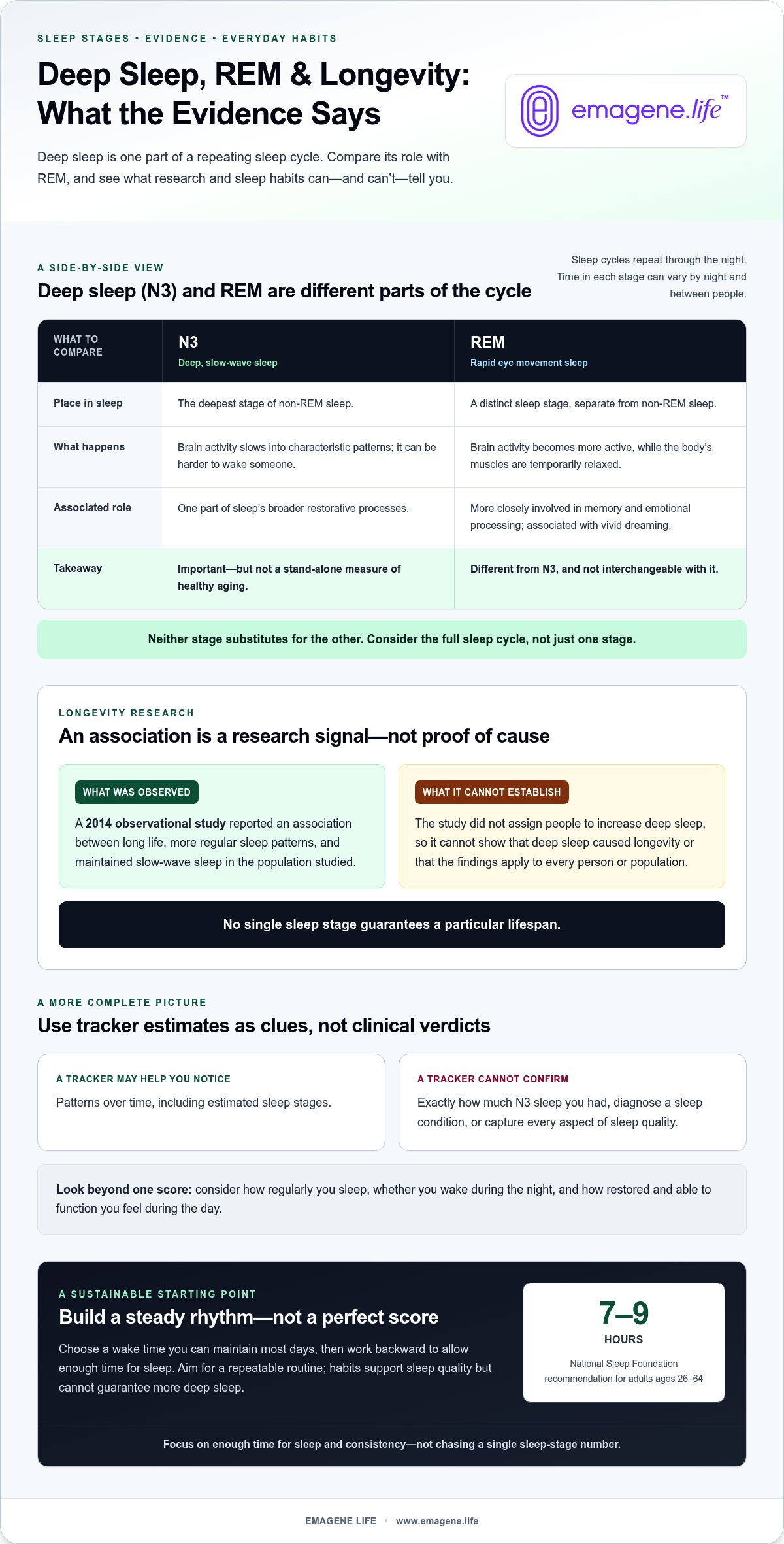
Deep sleep is slow-wave sleep, the deepest stage of non-REM sleep, while REM is a distinct stage associated with vivid dreaming and active brain processes. Deep sleep is also called N3. During it, brain activity slows into characteristic patterns, and it can be harder to wake someone. REM sleep has a different profile: brain activity becomes more active, and the body’s muscles are temporarily relaxed. Neither stage substitutes for the other.
Sleep moves through non-REM and REM stages in repeating cycles across the night. Time spent in each stage can vary from night to night and between people. Harvard Health’s explanation of REM offers useful context about its relationship to brain health and function, but it does not establish what deep sleep means for longevity. For a wider overview of the importance of sleep for overall health and longevity, consider the full sleep cycle rather than treating one stage as the whole story.
Does deep sleep itself make people live longer?
Research has reported an association between regular sleep patterns, maintained slow-wave sleep, and long life among the population studied. That observation is a reason to investigate the connection, not proof that more deep sleep causes people to live longer. The study’s population and design limit how confidently its findings can be applied to other groups or individuals.
That distinction matters. Sleep-stage patterns may occur alongside other influences on health and aging, and an association alone cannot show which factor drives an outcome. No single stage guarantees a particular lifespan.
Consumer wearables can estimate sleep stages, but those estimates aren’t definitive clinical measurements. A tracker’s deep-sleep number may help you notice patterns over time, yet it can’t confirm exactly how much N3 sleep you had or diagnose a sleep condition. Use the data as a prompt for reflection, not a verdict on your health. Optimizing deep sleep for longevity starts with a measured perspective: value sleep as part of healthy aging, but don’t mistake a metric or promising association for a personal forecast.
How Deep Sleep Supports Recovery, and What Longevity Research Can Establish
Sleep contributes to restoration, but it’s not accurate to assign every benefit to deep sleep alone. Mayo Clinic Press describes sleep as supporting processes that include tissue repair and memory processing. These functions involve sleep as a whole, with different stages contributing in different ways. Deep sleep is one part of that system, not a stand-alone longevity mechanism.
What happens during restorative sleep?
Across the night, the brain and body move through recurring stages. Some sleep processes support physical recovery; others help organize and retain information. REM sleep, non-REM sleep, and the transitions between them all belong to this broader rhythm. A tracker’s stage estimate can offer a rough view, but it can’t capture every aspect of sleep quality, such as whether you wake feeling restored or whether sleep is repeatedly interrupted.
Think beyond a single score. A device might estimate deep sleep, but that number alone doesn’t show how regularly you sleep, how often you wake, or how sleep affects your daytime function. A more complete view considers both the night and how you feel and function during the day.
How strong is the evidence connecting slow-wave sleep with longevity?
A 2014 observational study examined sleep patterns, including slow-wave sleep, among long-lived individuals. It reported an association between longevity, more regular sleep patterns, and maintained slow-wave sleep, alongside other measured factors. Because the study observed a particular population rather than assigning participants to increase deep sleep, it cannot establish that slow-wave sleep caused their longevity. Its findings also cannot be assumed to apply to every population or individual.
A 2014 study found an association between regular sleep patterns, maintained slow-wave sleep, and long life in the population studied, but it did not prove that deep sleep extends lifespan. That is a meaningful research signal, not a treatment instruction or a universal target for how much deep sleep a person should get.
For healthspan, the practical takeaway is to value sleep as one component of overall health without reducing it to a single stage or promising a particular lifespan outcome. Optimizing deep sleep for longevity means focusing on sustainable sleep quality while keeping claims proportional to the evidence. If sleep concerns sit alongside broader health questions, Emagene Life’s personalized functional medicine assessment can help explore potential underlying contributors and inform an individualized health roadmap.
How to Optimize Deep Sleep With a Sustainable Nightly Routine
No routine can guarantee more deep sleep. Instead, build the conditions for steadier, restorative sleep. Start with consistency and enough time in bed, then adjust your environment and evening habits to fit your life. Aim for a repeatable rhythm, not a perfect night or a perfect tracker score.
Which daily habits can support a steadier sleep routine?
Choose a wake time you can maintain most days, then work backward to allow enough time for sleep. The National Sleep Foundation recommends 7-9 hours for adults ages 26-64. If your schedule changes, aim for a realistic routine rather than abandoning it after one late night.
- Anchor your day. Keep wake and bedtime reasonably consistent. Get outdoor light during the day, especially in the morning when practical, and stay physically active in a way that suits your health and schedule.
- Create a short wind-down. Use a repeatable cue, such as dimming the lights, setting work aside, or choosing a quiet activity. A calm transition can make it easier to settle, even when you can’t follow the same detailed routine every night.
- Shape your sleep space. Aim for a dark, quiet, comfortable room. Adjust the temperature, bedding, or noise as needed; comfort is individual. Notice whether caffeine, alcohol, or a late, heavy meal seems to affect your sleep, then consider changing one factor at a time. There’s no single cutoff that suits everyone.
How should you use sleep trackers and adjust your routine?
Use data to spot patterns, not to grade yourself. Note bedtime, wake time, how rested you feel, and your daytime energy alongside any wearable estimates. Consumer devices can estimate stages, but they don’t provide a clinical measurement or diagnosis. If your deep-sleep score shifts while you feel well and function normally, don’t treat that number as a problem on its own.
Test one adjustment at a time and observe whether your overall sleep and daytime function change. For example, keep your schedule steady while moving late caffeine earlier, rather than changing several habits at once. This makes patterns easier to interpret and keeps the routine manageable. For a broader perspective on how sleep fits into healthy aging, explore The Science of Longevity: Extending Your Healthy Lifespan.
Optimizing deep sleep for longevity is best approached through sustainable foundations, not aggressive sleep-stage targets. If sleep difficulties coexist with broader health concerns, explore Emagene Life’s personalized Functional Medicine Assessment to consider potential underlying contributors and inform a health roadmap.
When Sleep Habits Are Not Enough: Explore the Wider Health Context
A steady routine can support better sleep, but it can’t resolve every cause of disrupted nights. If sleep remains difficult despite reasonable habit changes, don’t treat the problem as a failure of discipline. Persistent symptoms deserve attention beyond a tracker score or bedtime routine.
When should persistent sleep disruption be evaluated?
Consider seeking professional evaluation if trouble falling asleep or staying asleep keeps recurring, or if poor sleep substantially affects concentration, mood, energy, or daily activities. Loud snoring, gasping, or pauses in breathing noticed by someone else also warrant discussion with a healthcare professional. These signs don’t establish a diagnosis, but they are useful details to share during an assessment.
Keep a brief record of when sleep problems occur, your usual sleep and wake times, and how you feel during the day. Include observations from a bed partner if relevant. This context may help a professional decide what further assessment is appropriate. Avoid trying to diagnose the cause or relying on a device’s sleep-stage estimate to rule out a concern.
Sleep hygiene is supportive guidance, not a substitute for appropriate care. A dark, quiet room and consistent schedule may help create favorable conditions, but persistent disruption, breathing-related symptoms, or substantial daytime impairment should not be managed solely by adding more sleep hacks.
How can a personalized longevity assessment fit into the bigger picture?
Sleep concerns can coexist with other questions about health. Emagene Life’s Functional Medicine Assessment evaluates potential underlying contributors to health concerns and physiological imbalances. Its findings inform a personalized health roadmap that can place sleep within a broader view of individual health. It doesn’t replace appropriate evaluation of sleep symptoms, and it can’t promise improved sleep or a longer lifespan.
For details about the assessment, see Comprehensive Functional Medicine Assessment in Malaysia. If you’re also considering wider health goals, Emagene Life’s evidence-based longevity approach focuses on supporting a healthy lifespan through individualized care, not on guaranteeing a particular outcome.
Optimizing deep sleep for longevity means knowing when daily habits are a useful foundation and when persistent symptoms call for professional attention. Emagene Life’s longevity approach can be part of a broader, personalized focus on healthy aging.
Build a Healthspan Strategy That Lasts
Choose a next step you can sustain. Healthy aging isn’t a nightly performance target; it’s a long-term commitment to choices that support how you want to feel and function. Let sleep be one part of that broader picture, and give your routine room to adapt when work, family, or health needs shift.
Optimizing deep sleep for longevity doesn’t mean controlling every stage or chasing a perfect score. It means staying curious, noticing what supports your well-being, and seeking guidance when a concern persists. A measured approach leaves space for evidence, individual differences, and progress that builds over time.
If you’re ready to connect sleep with your wider health goals, explore Emagene Life’s personalized approach to longevity. Its work centers on individualized, evidence-based support for a healthy lifespan, without promising a specific outcome. Take the next step at a pace that fits your life. Small, thoughtful choices can help you move forward with clarity and confidence.
Frequently Asked Questions
Is deep sleep the same as REM sleep?
No. Deep sleep is the slow-wave stage of non-REM sleep, while REM is a separate stage marked by vivid brain activity and temporary muscle relaxation. They occur at different points in recurring sleep cycles, and a night includes both. Dreams can occur in other stages too, so remembering a dream doesn’t show how much REM or deep sleep you had. Each stage is part of a broader sleep pattern.
Can you increase deep sleep naturally?
You can support conditions that favor better sleep, but no routine can guarantee a measurable increase in deep sleep. Keep a regular schedule where practical, make time for enough sleep, and create a calm wind-down that fits your evenings. For example, if work sometimes runs late, choose a short, repeatable transition rather than an elaborate ritual. Optimizing deep sleep for longevity means supporting the whole sleep pattern, not forcing a specific stage.
Does more deep sleep mean you will live longer?
No. A study of long-lived participants reported an association between regular sleep patterns and maintained slow-wave sleep, but an observed association doesn’t establish that deep sleep caused longevity. It also can’t predict an individual’s lifespan. One person’s wearable estimate or a single night’s stage distribution isn’t a personal forecast. Treat the research as a reason to value sleep as part of overall health, not as proof that increasing one stage will extend life.
How much deep sleep do adults need?
There isn’t a universal, clinically established number of deep-sleep hours that every adult should target. Sleep-stage patterns vary between people and can change with age and from night to night. Focus first on total sleep: the National Sleep Foundation recommends 7-9 hours for adults ages 26-64 and 7-8 hours for adults 65 and older. These are total-sleep recommendations, not deep-sleep quotas.
Can a wearable accurately measure deep sleep?
A wearable can estimate sleep stages, but it can’t provide the same clinical measurement as polysomnography, a sleep study that records multiple body signals. Treat the device’s stage breakdown as an approximation, not a diagnosis or a precise score to chase. If you use a tracker, compare patterns over time and consider them alongside how rested you feel and how well you function, rather than reacting to one unusual night.
What should you do if you keep waking up during the night?
If awakenings keep recurring, interfere with daily life, or leave you substantially impaired during the day, seek professional evaluation. Note when you wake, whether you can return to sleep, and any daytime effects to help describe the pattern. Loud snoring or gasping during sleep also merits discussion with a healthcare professional. A sleep routine may be supportive, but it shouldn’t replace an assessment when symptoms persist.


