

Health Optimization for Men Over 40: 2026 Guide
What if the most effective approach to feeling stronger after 40 isn’t a dramatic overhaul, but a few consistent habits shaped around your health and your life? Health optimization for men over 40 starts with that shift: build a reliable foundation instead of chasing a single metric or quick fix.
You may already notice changes in energy, sleep, weight, or recovery. Conflicting advice can make those patterns harder to interpret, and a generic routine may not fit your health history or daily demands. A change doesn’t automatically point to one cause, but persistent symptoms are worth discussing with a clinician.
This guide covers practical ways to support strength, sleep, nutrition, movement, and long-term health. You’ll learn how to build sustainable habits, recognize when clinical input may help, and use personal patterns to guide your next steps. For a more individualized view, a Functional Medicine Assessment can bring together your health history, lifestyle patterns, and personalized diagnostics.
Key Takeaways
- Health optimization for men over 40 works best as a connected, sustainable approach, not a pursuit of one perfect metric.
- Movement, nutrition, sleep, and stress can support one another when you build them into a practical routine.
- Use a focused four-step plan: choose a priority, establish a baseline, make one change, and review your observations.
- Track a few meaningful patterns consistently instead of trying to monitor every health metric.
- A personalized assessment can connect your health history and lifestyle patterns with relevant diagnostics and a tailored plan.
Health Optimization for Men Over 40 Starts With the Whole Picture
Health optimization for men over 40 isn’t about chasing a perfect lab value or trying a quick fix. It means supporting day-to-day function and long-term well-being with sustainable habits, personalized to your needs and complemented by appropriate clinical care. The goal is a stronger foundation, not a promise that every change can be controlled.
Health optimization is the practice of building sustainable habits and using personalized care to support how you feel and function, rather than pursuing one number or a rapid result.
Energy, sleep, recovery, mood, and body composition can shift for overlapping reasons. A demanding work schedule, disrupted sleep, changes in activity, nutrition, stress, and health conditions may all be relevant. Age can be part of the context, but it doesn’t explain every symptom. A symptom alone also can’t establish a diagnosis or show that a hormone is the cause.
Why one symptom or number cannot tell the whole story
A single observation is a clue, not a complete explanation. Feeling unusually tired after a stretch of poor sleep, for example, may call for a different response than fatigue that persists despite changes in your routine. A lab result also needs context, including your health history and other relevant findings. Avoid self-diagnosing based on a symptom or standalone result. Note when a change began, whether it continues, and what else has changed. Share that pattern with a clinician, especially if symptoms persist, worsen, or affect daily life.
Hormones can be one part of a broader health picture, but they shouldn’t become the default explanation for every change in strength, energy, or mood. A clinician can consider your symptoms and personal history alongside appropriate testing before discussing what findings may mean.
The foundations that support health in midlife
Start with connected basics: regular movement, balanced nutrition, restorative sleep, and practical ways to manage stress. Add clinical follow-up when symptoms persist or a health concern needs attention. These foundations can influence one another, but they aren’t a rigid protocol or a guarantee of a particular outcome. Choose adjustments that fit your needs and routine, then notice how you respond.
Fitness and nutrition are familiar parts of men’s health coverage, including the broader lifestyle focus associated with Men's Health magazine on Wikipedia. The useful next step is to apply those themes to your own circumstances instead of copying a routine designed for someone else. The following sections turn these foundations into practical choices you can adapt and review over time.
How Movement, Nutrition, Sleep, and Stress Work Together
These foundations aren’t separate switches. A demanding day can leave less time for movement, a late night can affect how ready you feel to exercise, and stress can shape both eating choices and sleep. Health optimization for men over 40 means noticing these connections and building a routine that can flex with real life, rather than following a rigid plan.
Strength-focused movement and everyday activity play different roles. A planned session can challenge muscles, while walking for errands, taking the stairs, or standing and moving between tasks adds activity throughout the day. One doesn’t need to replace the other. A Harvard overview of long-term research on men's healthy aging discusses diet and lifestyle as relevant parts of the broader picture.
Build a sustainable movement and nutrition baseline
Choose activity you can repeat and adapt to your current ability. If you’re restarting, begin with manageable movement and build gradually instead of treating every session as a test. Strength-focused activity can complement regular daily movement. Your starting point should account for health concerns, discomfort, and past experience.
For meals, favor variety over rigid rules. Combine familiar sources of protein with vegetables or fruit, whole grains, and other nourishing foods that suit your preferences and circumstances. No single food needs to carry the whole plan. If you have symptoms, a medical condition, or questions about suitable changes, discuss your options with a clinician before making a major shift.
Protect sleep, recovery, and stress capacity
Notice patterns, not just isolated nights. You might jot down when you went to bed, how rested you felt on waking, which stressors stood out, and whether you felt recovered after activity. A short wind-down routine, a consistent sleep schedule, or a calm transition between work and home may help you prioritize rest. These are routine ideas, not treatments for sleep or stress disorders.
Movement, food, sleep, and stress are connected: a change in one can influence how manageable the others feel. Keep your approach flexible. Persistent or disruptive sleep, stress, or recovery problems deserve individualized clinical attention. To relate lifestyle patterns to your wider health picture, explore Emagene Life's functional medicine and longevity approach.
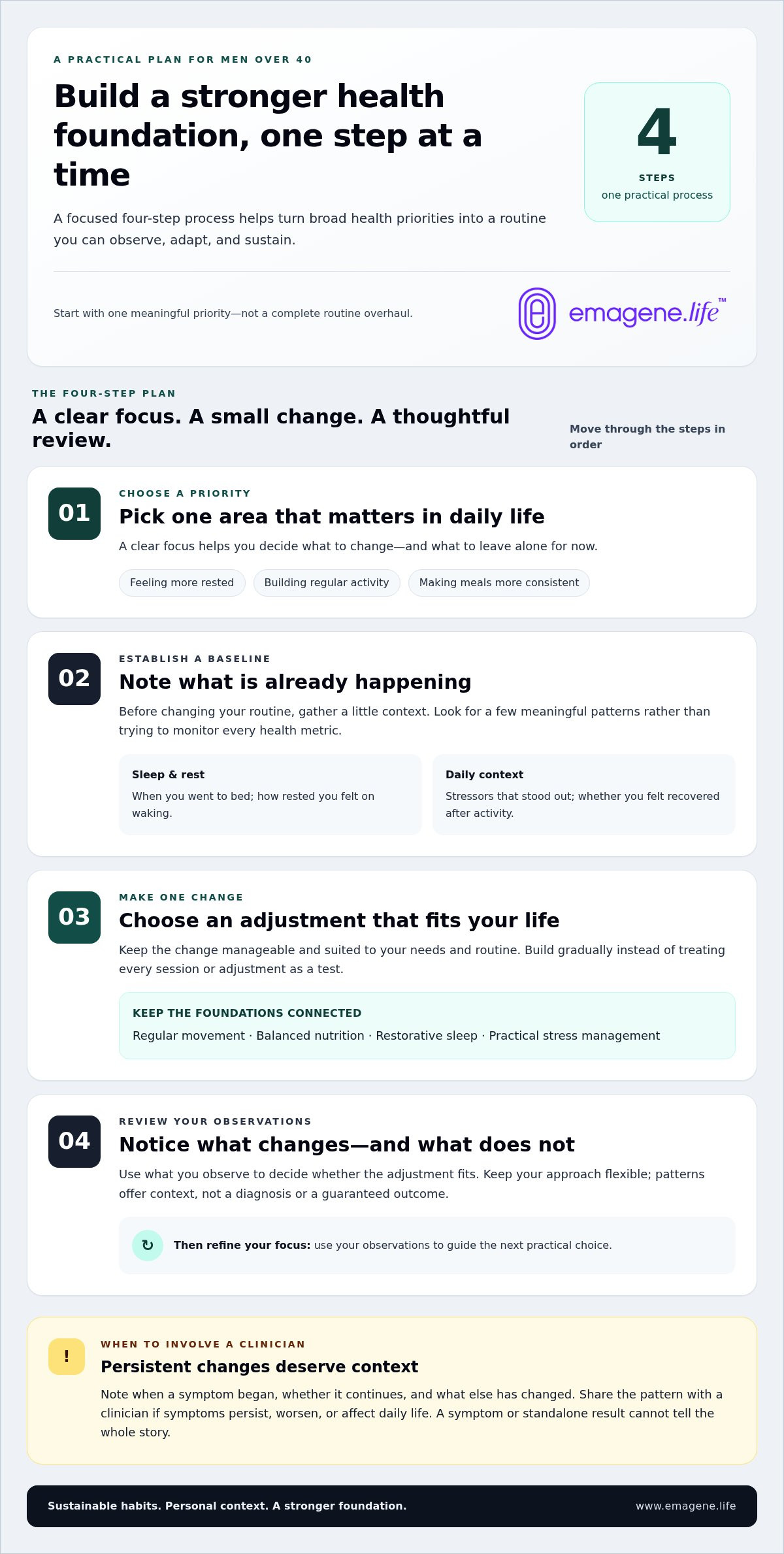
A Practical Health Optimization Plan for Men Over 40
A useful plan turns broad intentions into a repeatable process. Health optimization for men over 40 doesn’t require measuring everything or changing your entire routine at once. Start with one meaningful priority, gather enough context to understand your starting point, and adjust based on what you observe.
- Choose a priority. Pick one area that matters in daily life, such as feeling more rested, building regular activity, or making meals more consistent. A clear focus makes it easier to decide what to change and what to leave alone for now.
- Establish a baseline. Before changing your routine, note what’s already happening. Record a few relevant observations, such as sleep timing, daytime energy, activity, or a symptom you want to understand. Include context that may matter, like travel or a change in work demands.
- Make one change. Choose an adjustment that feels realistic for your schedule and current health circumstances. Changing one thing at a time can make it easier to judge whether the routine is sustainable and whether your observations shift.
- Review and adapt. Look back at your notes after following the change consistently. Keep what fits, revise what doesn’t, and avoid treating normal day-to-day variation as proof of success or failure.
Track patterns without turning health into a score
A simple personal log is enough. Note sleep, energy, activity, and any relevant symptoms in a format you’ll actually use. A few brief entries can reveal useful patterns without turning health into a stream of numbers or a daily pass-or-fail test. Look for context and trends, not a diagnosis. If you seek clinical guidance, these observations can help you explain what changed, when it began, and how it affects your routine.
Know when a personalized clinical conversation may help
Seek professional assessment for changes that persist, worsen, or concern you, especially if they interfere with daily functioning. Testing decisions should reflect your personal history, symptoms, and a clinician’s judgment. More tests aren’t automatically more useful. A screening result is one piece of information, not a complete assessment of your health.
For a more individualized next step, a Functional Medicine Assessment can connect your health history and lifestyle patterns with personalized analysis and a tailored plan. Explore a personalized Functional Medicine Assessment to bring those pieces into a clearer roadmap.
Turn Your Health Priorities Into a Personalized Roadmap
General habits can provide a starting point. A personalized assessment can connect your priorities with your health history, daily patterns, and relevant clinical information. At Emagene Life, the process includes a 30-90 min doctor consult, personalized analysis, and a tailored treatment plan. The aim is to make next steps relevant to you, not to prescribe the same testing or plan for everyone.
What a whole-person assessment brings together
An assessment considers more than one symptom or result. IFM-Certified Practitioners (IFMCP) bring your health history and lifestyle patterns into a whole-person analysis, then use clinical context to guide personalized diagnostics and interpretation. Depending on your needs, deep, comprehensive diagnostics may include DNA, NAD, Omega-3, biological age clocks, hormone panels, thyroid, gut microbiome, food sensitivities, and heavy-metal and toxin panels. The selection is personalized, not a checklist to complete in full.
Emagene Life has analyzed 3,000,000+ biomarkers. This informs a data-aware approach, while clinical interpretation remains central to understanding what findings may mean in your situation. The AI-powered Functional Medicine & Longevity Centre integrates the first-of-its-kind LLM by Avio Health, combining AI-supported analysis with human-led care.
Continue with personalized guidance and follow-up
An assessment is a starting point for a plan, not an isolated set of results. A tailored treatment plan can translate analysis into relevant interventions, with follow-up support and AI health-data tracking as part of the service. This gives the care team a way to review progress and consider whether the plan still fits as your circumstances and priorities evolve.
Virtual consultations and lab partnerships make Emagene Life’s services globally accessible. For men considering health optimization for men over 40, a personalized roadmap offers a structured way to connect observations, clinical insight, and appropriate next steps without reducing health to a single number.
To explore how a Functional Medicine Assessment could relate to your health priorities, learn more about Emagene Life’s approach.
Make Your Next Step More Personal
Your health priorities can evolve as your circumstances change. Treat your next step as a chance to understand what matters to you now, not as a demand to overhaul everything at once. A thoughtful plan can help turn questions about energy, strength, or daily well-being into a more focused clinical conversation.
For health optimization for men over 40, personalization matters. Emagene Life’s clinicians are IFM-Certified Practitioners (IFMCP), and its approach combines AI-supported analysis with human-led care and personalized follow-up. This creates space to connect your individual context with practical guidance, without reducing your health to a single result or quick fix.
If you’re ready to explore a more individualized perspective, learn about Emagene Life’s personalized health assessment. Use what you learn to choose a relevant, sustainable next step. Progress begins with a clearer understanding of your priorities, and you can build from there.
Frequently Asked Questions
Is it normal for men to feel less energetic after 40?
Energy can vary, but a change shouldn’t automatically be attributed to age. Sleep, stress, activity, nutrition, health history, and other individual factors may all be relevant. For example, note whether low energy follows disrupted sleep or continues across different routines. That context can help you decide what to discuss. If fatigue persists, worsens, or concerns you, seek professional guidance rather than assuming a cause or expecting a lifestyle change to resolve it.
Can lifestyle changes support testosterone health after 40?
Lifestyle is relevant to a whole-person discussion of health, including sleep, activity, nutrition, stress, and overall well-being. But you can’t assume a particular habit will raise testosterone or treat a hormone condition. Symptoms alone also can’t establish that a hormone problem is present. If changes persist or concern you, discuss them with a clinician, who can consider your personal history and whether further assessment is appropriate.
How much exercise should a man over 40 get?
There isn’t one routine that suits every man. Appropriate activity depends on current fitness, health, ability, and personal circumstances. A sustainable approach might combine movement built into daily life with strength-focused activity that fits your starting point. Begin gradually and adjust based on how you feel and recover. If a health concern, pain, or limitation could affect your exercise choices, discuss a suitable plan with a clinician.
What health checks should men over 40 consider?
Relevant health checks depend on your personal history, symptoms, and clinical judgment, so there isn’t one universal schedule for everyone. Bring questions about preventive care and any changes you’ve noticed to a qualified clinician, who can discuss what is appropriate for you. Tests can provide useful information, but results need to be interpreted alongside your circumstances. A single result rarely offers a complete explanation of your overall health.
Can I access Emagene Life consultations virtually?
Yes. Emagene Life offers virtual consultations and global access through telemedicine and lab partnerships. The service brings together clinician-led care, personalized diagnostics, and follow-up to connect relevant health information with ongoing guidance. Virtual access does not make the assessment one-size-fits-all; diagnostic choices and recommendations are personalized to your context. This offers a way to explore functional medicine and longevity support remotely.
What happens during an Emagene Life doctor consultation?
A 30-90 min doctor consult contributes to a personalized assessment. An IFM-Certified Practitioner (IFMCP) considers your health history alongside relevant diagnostics, then uses that context to inform tailored guidance and ongoing support. The consultation is part of a broader process, not a promise of a specific diagnosis or outcome. The assessment is individualized, so the information and next steps can reflect your needs rather than a fixed protocol.


