

How to Increase Healthspan and Lifespan: A Practical Guide
What if living longer matters less than how well you live along the way? A longer lifespan doesn’t automatically mean more years with energy, independence, and good health. That’s why learning how to increase healthspan and lifespan starts with a broader goal: supporting healthy function over time, not chasing a single longevity shortcut.
If health advice feels overwhelming or contradictory, you’re not alone. It can be hard to know which habits deserve your attention or whether a bold longevity claim is backed by evidence. Healthspan and lifespan are related, but they aren’t interchangeable, and a plan that suits one person may not fit another.
This guide explains the difference between the two and offers practical ways to build routines around movement, nutrition, sleep, and other aspects of health. You’ll also learn how to approach longevity claims carefully and how a personalized assessment can help organize health information and inform next steps. The aim isn’t to promise a particular outcome. It’s to support a practical, sustainable plan that you can discuss with a qualified clinician.
Key Takeaways
- Healthspan focuses on years lived in good health, while lifespan measures total years lived. Both matter when planning for healthy longevity.
- Genetics, daily behaviors, health history, and environment can interact to shape individual health over time.
- To explore how to increase healthspan and lifespan, choose one realistic priority, turn it into a small action, and review your progress.
- Build routines around your schedule, preferences, and health context rather than relying on rigid plans or one-size-fits-all advice.
- A personalized health assessment can organize health information and support more focused discussions about next steps.
Healthspan and Lifespan: Why More Years Matter Most When You Can Thrive
The goal isn’t simply to add years. It’s to support more years in which you can take part in the activities and relationships that make life meaningful. Lifespan is the total time a person lives; healthspan is the time spent in good health. These ideas are connected, but they describe different outcomes. Lifespan counts the years you live; healthspan reflects how well you’re able to live them.
This distinction can shape the questions you ask about longevity. Instead of focusing only on how long you might live, consider what you want to preserve: mobility, clear thinking, the ability to manage daily tasks, or the energy to stay engaged with family and community. These are personal goals, not guarantees of a particular outcome. A useful starting point is this foundational overview of what healthspan means.
What Does Healthspan Mean in Everyday Life?
Healthspan is about well-being and maintaining the capacity to do what matters to you. That might mean preparing meals, walking to nearby errands, keeping up with a hobby, or making decisions with confidence. Your priorities may differ from someone else’s, and they can change over time.
No single test result captures the full picture. A diagnosis may offer important health information, but it doesn’t describe someone’s daily function, sense of well-being, or independence by itself. Aging and illness can’t always be prevented. A more realistic aim is to support health and function while adapting to changing needs.
Why Lifespan and Healthspan Are Not Interchangeable
A person may live longer without every added year being spent in good health. That’s why longevity is best considered alongside quality of life. Supporting both means paying attention not only to survival, but also to the physical and mental capabilities that help you participate in everyday life.
Think of healthspan as a practical lens for deciding what you value and what you want to discuss with a qualified clinician. If your priority is staying active, for example, bring that goal into conversations about your health rather than chasing a single number or trend. Advice about how to increase healthspan and lifespan should account for your circumstances, health history, and preferences. No plan can guarantee a longer life or prevent every condition, and individual outcomes vary. The aim is informed, sustainable support for the years ahead.
What Shapes Healthspan and Lifespan? Understand the Interacting Factors
There isn’t one switch that determines how a person ages. Genetics can influence predispositions, while health history, daily routines, and the surrounding environment also shape the picture. These influences overlap. A demanding work schedule, for example, may affect sleep and meal routines; symptoms or a past diagnosis may change which forms of movement feel manageable. The same habit can fit one person and need adapting for another.
Longevity planning works best when it considers the whole person, because health influences interact rather than operate in isolation. Nutrition, movement, sleep, and stress are useful areas to consider, but none acts as a guaranteed lever. A single supplement or routine can’t account for every part of someone’s health.
How Daily Habits Interact With Long-Term Health
Daily habits are connected. A routine that supports restful sleep may make it easier to feel ready for movement; movement, in turn, can be part of a broader approach to well-being. Food choices, stress, and available time may affect how realistic that routine feels. Instead of chasing a shortcut, focus on patterns you can sustain and adapt. Progress doesn’t require perfect days.
Why Personal Health Context Changes the Starting Point
Symptoms, health history, work and family routines, and personal goals all help define a sensible starting point. Someone managing ongoing symptoms may need a different plan from someone focused on maintaining an established routine. General wellness information can help you frame questions, but it can’t determine what a symptom means or provide individualized care. Bring health concerns and relevant history to a qualified clinician rather than trying to diagnose or treat a condition from an article.
For a practical first step, note what feels steady in your routine, what feels difficult, and what you most want to support. That gives you a clearer basis for a clinician conversation. Emagene Life’s Functional Medicine Assessment brings together health history, personalized diagnostics, and whole-person analysis to help inform individualized next steps. Learn more about Emagene Life’s personalized functional medicine assessment. Any plan should reflect your circumstances, and no approach can promise a particular health outcome or lifespan.
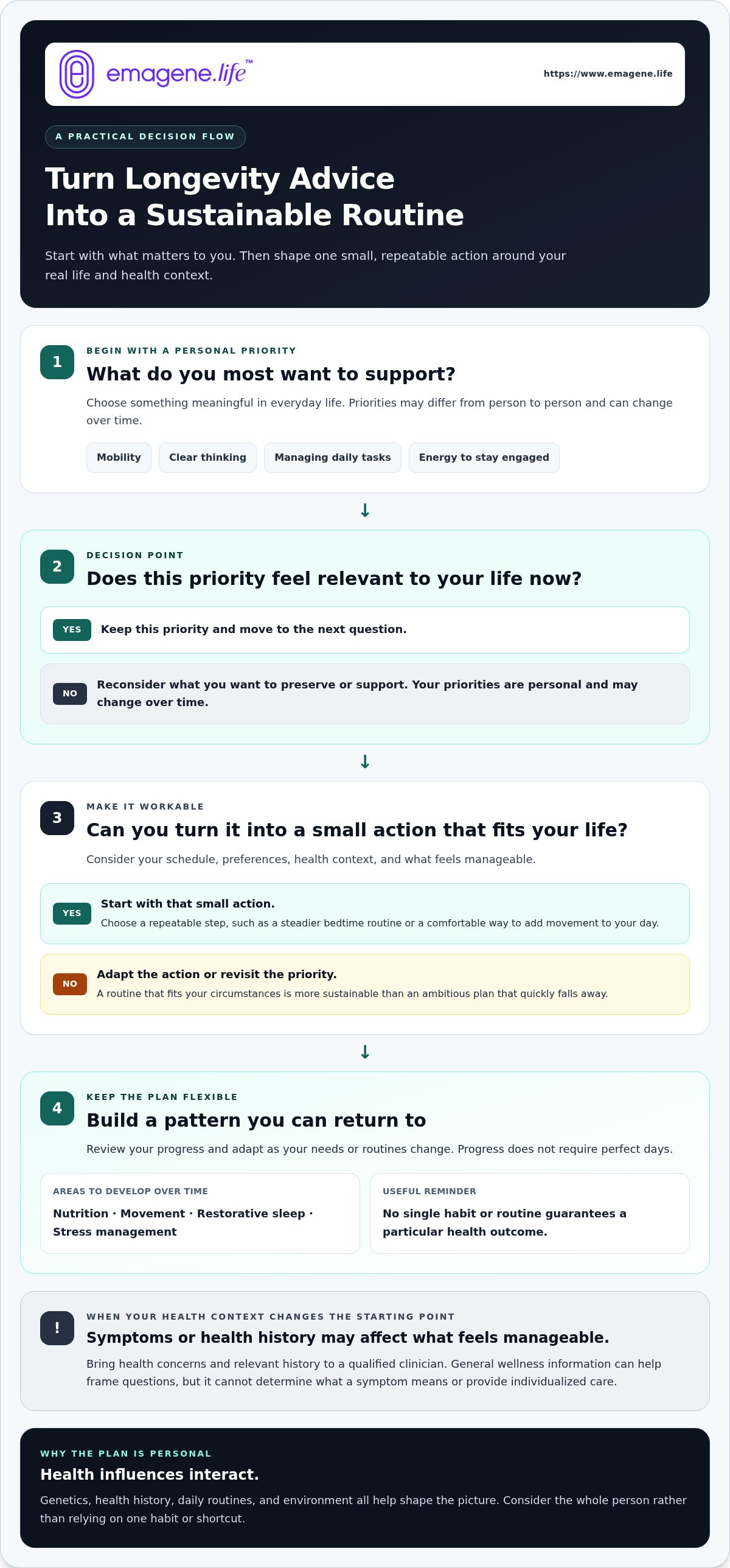
How to Build Sustainable Habits That Support Healthspan
Longevity advice can make healthy aging sound like a demanding project. Start smaller. A routine you can repeat is more useful than an ambitious plan that quickly falls away. Build health with habits you can return to, not dramatic interventions you can’t sustain. Nutrition, movement, restorative sleep, and stress management are useful areas to develop over time, with choices shaped by your preferences and health context.
Use this flexible sequence to turn intention into action:
- Choose a priority. Pick one area that feels relevant now, such as creating a steadier bedtime routine or finding a comfortable way to add movement to your day.
- Define a small action. Make it clear and realistic for your schedule. For example, you might prepare an enjoyable meal at home or take a brief walk during a break, if that suits your needs.
- Track the behavior. Use a note or calendar to record whether you did the action. Focus on the routine, not on expecting a specific medical result.
- Review and adjust. Keep what works. If the action repeatedly feels difficult, make it smaller or choose a different approach.
Choose a Starting Point You Can Repeat
Ask yourself: Which routine could support my well-being, and what version can I realistically repeat? A movement plan should fit your current ability and circumstances; a nutrition change should work with your preferences and daily life. The best starting point isn’t necessarily the most ambitious. It’s a relevant action that feels manageable enough to continue. If symptoms or a health condition affect what feels appropriate, discuss changes with a qualified clinician.
Review Progress Without Chasing Quick Fixes
Pause periodically to reflect on consistency, energy, everyday function, and whether the habit still supports your goals. These observations can help you decide what to maintain or change, but subjective well-being doesn’t replace clinical assessment. Avoid extreme routines, supplements promoted without sound support, or claims that any intervention guarantees results. If a change raises concerns, seek individualized clinical guidance rather than pushing through.
For people considering how to increase healthspan and lifespan, a personalized approach can help connect sustainable routines with individual health priorities. Emagene Life’s Functional Medicine Assessment combines deep, comprehensive diagnostics with health history and whole-person analysis to help guide personalized next steps.
How Personalized Health Assessment Can Guide Your Longevity Next Steps
General guidance can help you think about healthy routines. A personalized health assessment adds context by bringing health information, history, and priorities into one discussion. This can help you and a clinician consider which next steps may be relevant to you. An assessment doesn’t predict exactly how long you’ll live or guarantee a particular result. Its value is a more organized starting point for informed decisions.
From Health Data to a Personalized Plan
Emagene Life combines Precision Diagnostics & Deep Health History Analysis with Whole-Person Lifestyle & Systems Analysis. Personalized diagnostics may include DNA, NAD, Omega-3, biological age clocks, hormone panels, thyroid, gut microbiome, food sensitivity, and heavy-metal and toxin testing. The whole-person analysis considers factors such as the gut-brain-hormone axis, stress and sleep patterns, inflammatory triggers, and nutrient gaps. These details are considered alongside your concerns and goals to inform a tailored plan and follow-up support. Emagene Life has over 3,000,000 biomarkers analyzed, and the process includes a 30-90 min doctor consult.
This context matters. The same finding may lead to different conversations depending on a person’s history, symptoms, and priorities. Assessment can help organize information, but a result alone isn’t a diagnosis or a reason to start or stop treatment. Discuss its meaning and any proposed changes with a qualified clinician.
Where AI and Human-Led Care Fit
Emagene Life is an AI-powered Functional Medicine & Longevity Centre that integrates a first-of-its-kind LLM by Avio Health with human-led care. AI-driven analysis supports the process of organizing health information; it doesn’t replace clinical judgment. Care is led by IFM-Certified Practitioners (IFMCP), who provide professional guidance when discussing findings and individualized next steps.
This combination can help structure complex information while keeping personal context and clinician input central. Use an assessment to develop clearer questions, understand how your history informs the discussion, and consider a plan that fits your needs. It’s one measured step in exploring how to increase healthspan and lifespan, not a promise of extended life or freedom from illness.
Emagene Life also provides ongoing support and follow-up, including progress reviews and an AI health-data tracker, as part of its personalized approach to functional medicine and longevity.
Make Your Next Longevity Step Personal
Your health priorities can change as your life changes. Treat longevity planning as an ongoing conversation, not a fixed blueprint or a test you either pass or fail. The most useful next step is one that reflects what matters to you now and gives you a clearer basis for future decisions.
As you consider how to increase healthspan and lifespan, keep your expectations grounded: no assessment or routine can guarantee a specific future. Bring your questions, goals, and health concerns into a thoughtful discussion with a qualified clinician. That turns broad longevity advice into a more relevant path forward.
Emagene Life combines AI-powered analysis with human-led care from IFM-Certified Practitioners (IFMCP), supported by over 3,000,000 biomarkers analyzed. If personalized guidance feels like a useful next step, explore Emagene Life’s Functional Medicine Assessment and longevity support.
Build your next step around your life, your priorities, and the possibility of more healthy years.
Frequently Asked Questions
Can you increase healthspan without changing everything at once?
Yes. You can begin with one manageable habit rather than changing your entire lifestyle. For example, you might attach a short walk to an existing errand or set a consistent cue for winding down at night. Keep a simple record of whether you did it, then adjust if it doesn’t fit your week. This is general wellness guidance, not individualized medical advice; discuss personal health concerns with a qualified clinician.
Can a DNA test predict how long you will live?
No. A DNA test can’t precisely tell you how long you’ll live. Genetic information may describe selected inherited factors, but lifespan also reflects health history, behaviors, environment, and events that a test can’t forecast. Treat results as one piece of information, not a complete prediction or a promise of disease prevention. If you receive genetic findings, review their meaning and limitations with a qualified clinician before making health decisions.
Do longevity supplements increase lifespan?
Claims that a supplement extends lifespan deserve caution; no product should be treated as a proven guarantee of longer life. A supplement may also be inappropriate for your circumstances or interact with other treatments. Don’t start, stop, or combine products based only on marketing or an online article. Share the product name and ingredient list with a qualified clinician, especially if you have a health concern or take medication.
Can healthspan improve when someone is managing a chronic condition?
Supporting daily well-being can still matter while you manage a chronic condition, though what’s realistic and helpful varies by person. A goal might be preserving the ability to prepare meals or maintain a valued social activity, rather than pursuing an intensive new routine. Lifestyle changes aren’t a substitute for condition-specific care or a cure. Coordinate changes with your qualified clinician, who can consider your treatment and circumstances.
Is biological age the same as lifespan?
No. Lifespan describes how long someone lives; biological age is an estimate based on selected health data and the method used. It can offer a limited perspective, but it isn’t a countdown or a complete account of physical and mental well-being. Results need context and shouldn’t be used alone to diagnose a condition or forecast an individual’s lifespan. Discuss questions about a result with a qualified clinician.
How do I know which healthspan habit to prioritize first?
Start with the area that matters most to your daily life and feels realistic to address. Consider what your current routine allows, what goal you want to support, and whether a health concern affects your options. Then choose one specific behavior, such as planning a regular time for a walk, and review whether it fits. This offers a practical starting point for how to increase healthspan and lifespan. Persistent symptoms call for clinical guidance, not self-diagnosis.


