

Far Infrared Therapy or a Traditional Sauna for Longevity?
A hotter sauna isn’t automatically better for longevity. Far infrared therapy for longevity may affect processes such as circulation and cellular energy production, but it has not been shown to extend lifespan. Far infrared saunas use infrared wavelengths to warm the body directly, while traditional saunas heat the surrounding air.
Both approaches use heat, but deliver it differently. That distinction matters when weighing comfort, potential effects on the body, and what the evidence can tell you about healthy aging.
This article explains how far infrared therapy works and how it may affect blood flow, inflammation, oxidative stress, and mitochondrial activity. You’ll also see how these proposed effects compare with traditional sauna use, where the evidence has limits, and why neither approach should replace medical care. The aim is a clear, grounded comparison to help you consider sauna use as one part of a broader approach to longevity.
Key Takeaways
- Understand how far infrared heat differs from traditional sauna heat, and why the experience may matter when comparing the two.
- Learn how proposed effects on circulation and cellular energy relate to longevity, without treating a possible mechanism as proof of a longer lifespan.
- Explore how inflammation, oxidative stress, and tissue recovery fit into the discussion of infrared therapy.
- Use the strength and type of available evidence to assess what sauna research can, and cannot, tell you.
- Consider sauna use as one part of a broader longevity approach, rather than a replacement for medical care or personalized health planning.
How Does Far Infrared Therapy Work?
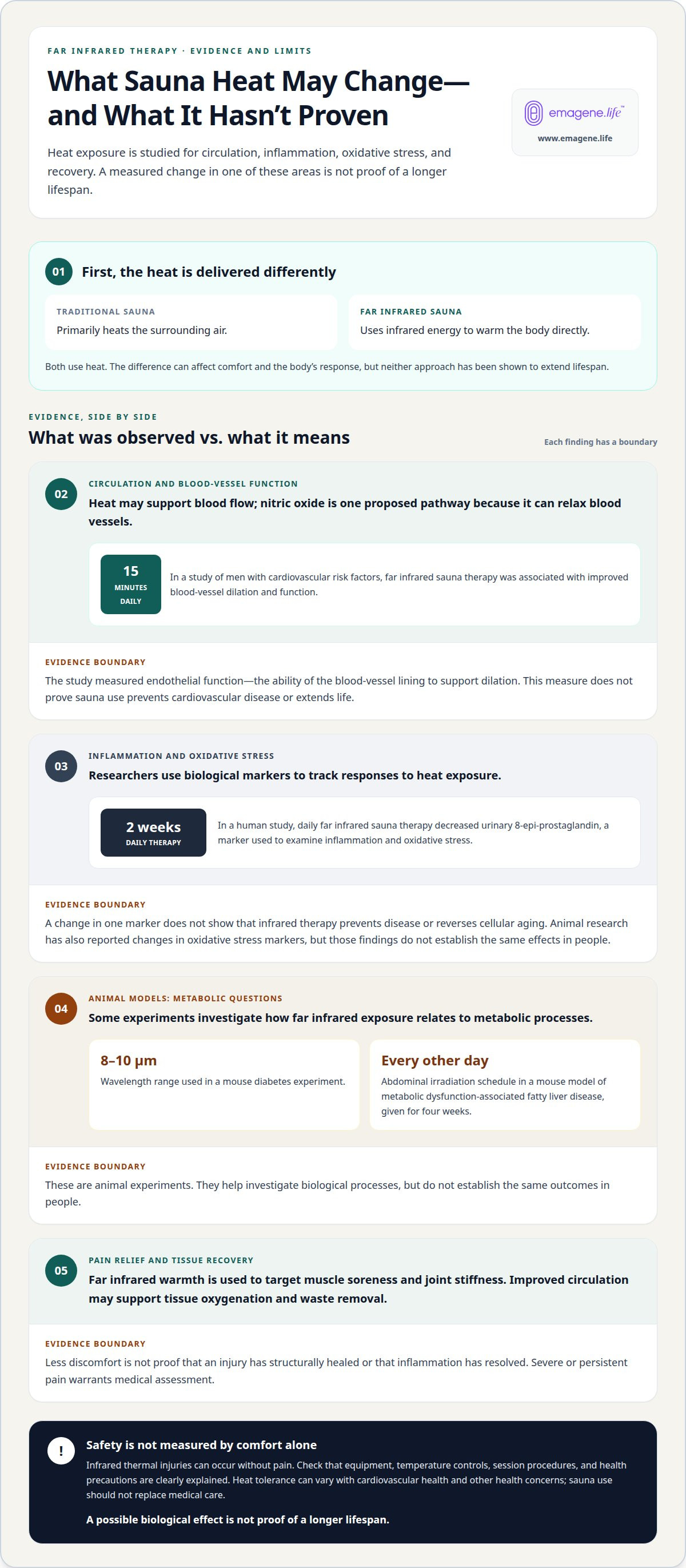
Far infrared saunas warm the body using infrared energy, while traditional saunas primarily heat surrounding air. Their cardiovascular effects are linked to circulation, blood-vessel function, and changes in body temperature.
Cardiovascular effects and blood pressure
Cardiovascular effects include changes in circulation, blood-vessel function, and blood pressure during or after heat exposure. These measures matter because blood vessels help deliver oxygen to tissues and regulate the heart’s workload.
Infrared saunas are associated with improved circulation and lower blood pressure. One proposed mechanism is the release of nitric oxide, which can relax blood vessels and support blood flow. The effects of heat vary with a person’s cardiovascular health and response to rising temperature.
In a study of men with cardiovascular risk factors, far infrared sauna therapy for 15 minutes daily improved blood vessel dilation and function, according to The study authors. The outcome measured endothelial function, or how well the inner lining of blood vessels supports dilation. This is a clinical measure, not proof that sauna use prevents cardiovascular disease.
That distinction matters when considering far infrared therapy for longevity. Better circulation may support oxygen delivery, but a change in one vascular measure does not establish a longer life or lower cardiovascular risk. If you’re considering sauna use alongside medical care, discuss your health history and blood-pressure response with a qualified clinician.
Proposed biological effects
Proposed biological effects describe how infrared exposure might influence blood vessels, inflammation, and cellular processes. These mechanisms matter because circulation and tissue repair are connected, but a proposed pathway does not demonstrate slower cellular aging.
Infrared light is described as penetrating several centimeters into the skin. Far infrared energy can create gentle heat, raise tissue temperature, and potentially affect blood-vessel relaxation. The resulting effects may include improved circulation, which can support tissue oxygenation and waste removal.
Research also examines biological responses beyond human cardiovascular studies. In a mouse diabetes experiment, far-infrared light was applied at a wavelength range of 8-10 μm, according to The study authors. In a mouse model of metabolic dysfunction-associated fatty liver disease, abdominal far-infrared irradiation was given every other day for four weeks, according to The study authors. These animal models investigate metabolic processes; they do not establish the same outcomes in people.
In Malaysia, far-infrared therapy may be available at facilities offering infrared sauna sessions. To assess safety and credibility, look for clear explanations of the equipment, temperature controls, session procedures, and relevant health precautions. Ask how staff respond if someone feels unwell. Infrared thermal injuries can occur without pain, so comfort alone cannot confirm safe exposure. A medical discussion is particularly relevant if cardiovascular conditions or other health concerns could affect your tolerance of heat.
Inflammation, oxidative stress, and tissue regeneration
Researchers study far infrared exposure for its effects on inflammation, oxidative stress, and tissue recovery. A urinary marker can offer one way to examine these responses in people.
Inflammation and oxidative stress markers
Inflammation and oxidative stress markers are measurable signals that help researchers track biological responses. Urinary 8-epi-prostaglandin, for example, is used as a marker of inflammation and oxidative stress. In a human study, two weeks of daily far infrared sauna therapy decreased this marker, according to The study authors. The result describes a measured change, not proof that infrared therapy prevents disease or reverses cellular aging.
Oxidative stress occurs when reactive molecules outpace the body’s defenses, potentially affecting cell function and tissue. In an animal model of congestive heart failure, four weeks of far infrared therapy was associated with lower oxidative stress markers and stronger cellular defenses. This finding helps explain why researchers study infrared exposure in disease models. It does not establish the same effect in people or show that sauna sessions remove toxins through cellular detoxification.
Inflammation is part of the body’s response to injury, but persistent inflammation can interfere with normal tissue function. Infrared exposure is proposed to support circulation, oxygen delivery, and waste removal, which could contribute to tissue repair. Wavelengths, exposure conditions, and a person’s health all shape the biological response, so one marker cannot represent every inflammatory pathway.
Pain relief and tissue regeneration
Pain relief and tissue regeneration are separate outcomes: one concerns a change in discomfort, the other the repair of damaged tissue. Far infrared heat is used to target muscle soreness and joint stiffness. It’s important to distinguish symptom relief from structural healing: feeling less pain does not by itself show that an injury has healed or inflammation has resolved.
Improved blood circulation can support oxygenation and the removal of cellular waste from tissue. These processes are relevant to recovery after muscle strain or irritation, while near-infrared light is often used for surface injuries and inflammation. Far infrared approaches generally aim to provide deeper warmth and relieve discomfort. Neither wavelength category should replace medical assessment when pain is severe or persistent.
Evidence for regeneration spans different settings, including laboratory cells, animal models, and human studies. Each answers a different question. A biomarker change, such as the 8-epi-prostaglandin result, is not the same as faster recovery, restored function, or reduced disease risk. Keep those outcomes distinct when judging claims about infrared therapy.
For a broader view of factors linked to inflammation and recovery, explore personalized functional health assessment.
Mitochondrial function and cellular energy production
Medical organizations and regulators distinguish biological mechanisms from demonstrated longevity outcomes. Infrared-related changes in cellular activity do not, on their own, establish that therapy extends life or prevents disease.
Mitochondria generate much of the energy cells use to maintain their function. Far-infrared energy is absorbed by cellular chromophores, including cytochrome c oxidase, an enzyme in mitochondria. Researchers are investigating whether this interaction can influence mitochondrial activity and ATP production. ATP supplies energy for processes such as cellular maintenance and repair, but a proposed mechanism is not the same as a proven health outcome.
One laboratory example helps clarify the evidence. After 60 minutes of far-infrared irradiation, researchers observed increased mitochondrial function in RIN-m5f cells. This finding concerns a cell model, not a person using a sauna. It identifies a biological response under experimental conditions; it does not show that infrared exposure improves energy production throughout the human body or slows aging.
Oxygen also plays a role in cellular energy production. Mitochondria use oxygen in the processes that produce ATP, while cellular stress can affect how efficiently cells function. Infrared therapy is proposed to influence mitochondrial activity, but this does not establish that it reduces oxidative damage in people. A change in the function of a cell in a laboratory cannot be translated directly into an individual longevity benefit.
Claims about detoxification and cellular renewal need the same precision. Sweating during heat exposure is a physical response; it does not, on its own, demonstrate that the body has removed harmful substances or repaired damaged cells. Likewise, “cellular renewal” can refer to different processes, from ordinary maintenance to tissue regeneration. Each claim needs evidence tied to the specific process described.
Cellular oxidative damage is studied in aging research, but it is not a single measure of biological age. A study showing altered mitochondrial activity does not establish a change in lifespan, disease risk, or cancer outcomes. These are distinct endpoints, assessed at different levels, from cells to people. Before interpreting a result, be clear about what kind of evidence it represents.
To assess far infrared therapy for longevity, separate three questions: what happens to cells in a laboratory, what changes in human clinical studies, and whether those changes improve meaningful health outcomes. Research on infrared and mitochondria addresses the first question. It cannot answer all three without corresponding evidence in people and outcomes relevant to healthy aging.
Far infrared therapy compared with traditional saunas
Traditional saunas heat the surrounding air; infrared saunas use specific wavelengths to warm the body directly. This changes how heat is delivered, not the basic comparison: both expose the body to heat, but by different routes. A traditional sauna warms the room first, while infrared energy transfers warmth directly to the body. This distinction can shape comfort and the kind of exposure a person experiences, but it does not establish which method is better for longevity.
Far-infrared treatments are described as reaching 1.5 inches deeper into the skin than traditional sauna methods when used daily. Treat this as a comparison of penetration, not proof of deeper healing or greater relief. The sauna’s heating mechanism also does not establish superior cardiovascular effects. Outcomes depend on what a study measures, such as blood-vessel function, rather than whether the room or body is heated first.
Duration is another difference in how sauna protocols are designed. There is no single session length that applies to every infrared sauna, traditional sauna, or health goal. Duration depends on the device’s heat delivery, the intended outcome, and the person’s response to exposure. For example, a study measuring cardiovascular changes answers a different question from one examining muscle discomfort. Session time alone cannot predict either result.
For aging, the key issue is the outcome being measured. A study may assess a temporary response to heat, a cardiovascular measure, or a cellular process. These outcomes are not interchangeable with changes in lifespan or age-related disease. Infrared sauna use may be part of a broader health routine, but the heating method alone cannot establish that it slows aging. Keep claims about cellular renewal separate from demonstrated effects in people.
Choose based on the experience and the evidence relevant to your aim, not on claims that one sauna is universally superior. If warmth and muscle relief are priorities, comfort during exposure may matter. If cardiovascular health is the focus, look at studies measuring cardiovascular outcomes. Neither the air-heating approach of traditional saunas nor direct infrared heating replaces medical care. In Malaysia, a clinician can help account for existing health conditions when heat exposure is being considered.
For a personalized perspective on longevity, explore a functional medicine approach.
Emagene Life: Longevity
Emagene Life supports longevity through functional medicine and personalized wellness strategies focused on healthy lifespan. If you’re weighing sauna use alongside broader health priorities, a Functional Medicine Assessment can help identify health concerns and physiological imbalances relevant to your goals.
Far infrared exposure is one topic in a wider longevity conversation, not a substitute for understanding your overall health. Functional medicine considers the factors contributing to your health picture. Hormone Optimization may be relevant when hormone health is part of that picture. The focus is a more complete, personalized approach, rather than treating one sauna method as a standalone solution.
To explore a personalized approach to longevity, get in touch with Emagene Life.
Make Longevity Decisions With Your Whole Health in View
Choose health strategies based on how they fit your needs, not the appeal of a single intervention. Far infrared therapy for longevity is one consideration. A useful next step is to understand the broader factors shaping your health and healthy lifespan.
Emagene Life offers Longevity, functional medicine, and Functional Medicine Assessments to help explore health concerns and physiological imbalances. This broader perspective can place wellness choices within an individualized health plan, rather than treating sauna use as a standalone answer. The goal is informed progress that reflects your priorities.
If you’re ready to explore a personalized approach to longevity, Contact Emagene Life. Take the next step with clarity, and build your health decisions around the bigger picture.
Frequently Asked Questions
Are devices purchased for at-home use a safe, reasonable option?
An at-home infrared device can be a practical wellness option for some people, but home use does not eliminate heat-related risks. Infrared thermal injuries can occur without pain, so discomfort alone is not a reliable safety signal. Guidance for infrared therapy advises pregnant people, people with heart disease, and people who are sick to avoid it. Follow the device’s instructions and consider whether heat exposure is appropriate for your health.
What Causes Aging?
Aging reflects interacting changes in cells and body systems, rather than one isolated cause. Genetic influences, environmental exposures, and accumulated cellular wear can affect how tissues maintain and repair themselves over time. Oxidative stress and changes in mitochondrial function are among the processes studied in aging research. These mechanisms help explain why longevity is broader than a single intervention, but they do not provide a simple measure of an individual’s biological age.
What is Far Infrared Detox?
“Far infrared detox” describes the claim that infrared sauna heat helps the body eliminate toxins, sometimes through sweating. Sweating is a response to heat, but sweat alone does not show which substances the body has removed or whether exposure improves health. Treat detoxification claims separately from measured outcomes, such as changes in a laboratory marker. Sauna sessions should not replace medical care or a prescribed treatment plan.
What is far-infrared therapy, and how is it used for longevity?
Far-infrared therapy exposes the body to far-infrared energy, often through a sauna, to produce warmth. “Longevity” refers to its proposed role in supporting healthy aging, not a demonstrated extension of lifespan. Research examines responses such as blood-vessel function and cellular activity. If you’re considering far infrared therapy for longevity, the useful distinction is between studying a biological response and demonstrating a lasting improvement in health.
What scientific evidence links far-infrared therapy to lifespan or healthy aging?
The studies described measure biological responses, not lifespan. Human clinical research has assessed outcomes such as blood-vessel function and markers related to inflammation or oxidative stress. Other research examines cells or animal models. These findings can inform further study, but do not establish that far-infrared therapy extends life or prevents age-related disease. Look at the specific outcome measured before drawing conclusions about healthy aging.
What temperatures and session durations are typically used for far-infrared sauna therapy?
Temperature and session duration depend on the sauna protocol, and the available study example does not establish a universal routine. In a study of men with cardiovascular risk factors, far-infrared sauna therapy was used for 15 minutes daily for two weeks, according to The study authors. That protocol describes one study, not a general prescription. Use the device’s stated instructions and account for individual heat tolerance.


