

Natural Ways to Improve Mitochondrial Function With Food
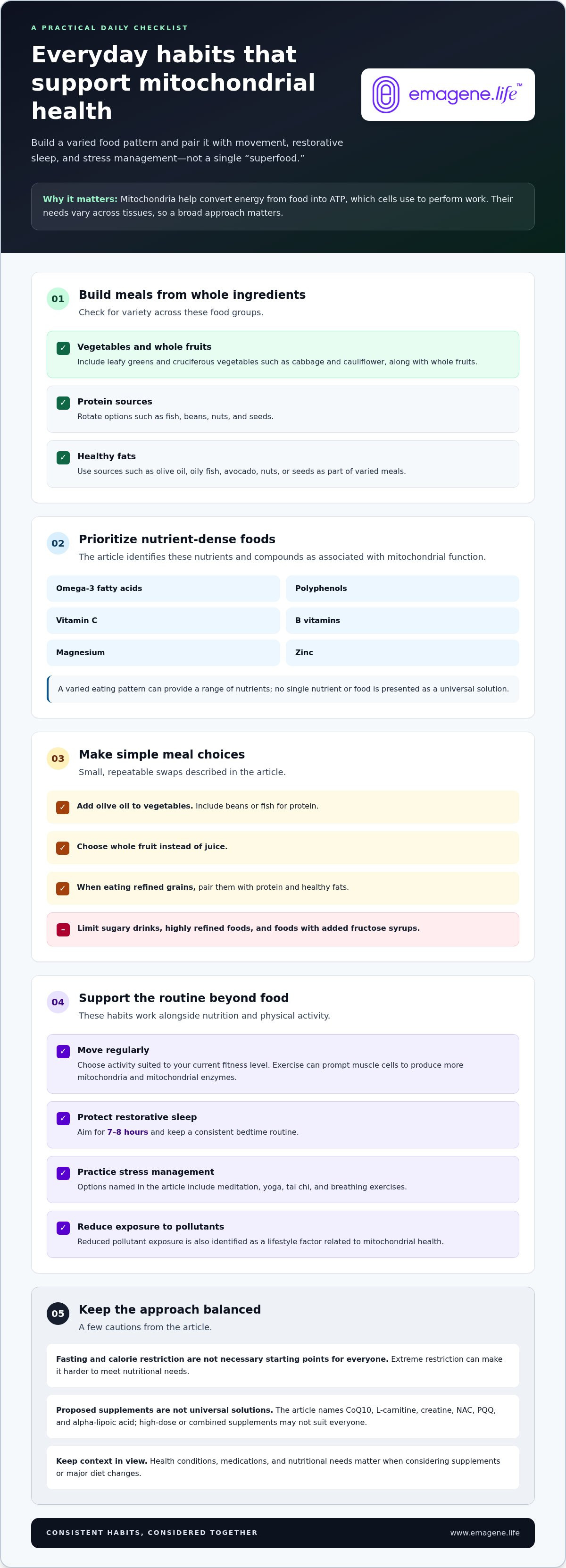
Mitochondrial health is influenced by daily habits, not a single “superfood.” Natural ways to improve mitochondrial function include eating a varied, plant-forward diet with healthy fats and nutrient-rich foods, getting restorative sleep, managing stress, and exercising regularly. Together, these habits support the cellular systems that help your body produce energy.
Mitochondria are structures inside cells that generate much of the energy your body uses. Their needs vary across tissues, so supporting them means looking beyond one nutrient or supplement. Leafy greens, whole fruits, fish, beans, nuts, and seeds provide nutrients associated with mitochondrial function. Sugary drinks and highly refined foods are worth limiting.
Movement matters, too. Exercise can prompt muscle cells to produce more mitochondria and mitochondrial enzymes, making physical activity a practical part of a broader approach to mitochondrial health. This guide explains what mitochondria do, which nutrients and foods may support their function, and how to make exercise part of a consistent, sustainable routine.
Key Takeaways
- Build meals around a variety of vegetables, whole fruits, whole grains, and protein sources such as fish, beans, nuts, and seeds.
- Prioritize nutrient-dense foods that supply compounds associated with mitochondrial support, including omega-3 fats, polyphenols, B vitamins, and magnesium.
- Choose regular movement that suits your current fitness level; exercise can encourage muscle cells to produce more mitochondria and mitochondrial enzymes.
- Support mitochondrial health with consistent sleep and stress-management habits alongside nutrition and physical activity.
- Consider a Functional Medicine Assessment if you want to explore how your health patterns and physiological needs relate to a personalized approach.
1. What Nutrients Support Mitochondrial Function?
Which foods and nutrients support mitochondrial health? Choose leafy greens, cruciferous vegetables such as cabbage and cauliflower, whole fruits, fish, beans, nuts, and seeds. These foods provide nutrients and healthy fats associated with mitochondrial function, including omega-3 fatty acids, polyphenols, vitamin C, B vitamins, magnesium, and zinc.
Build meals from whole ingredients. Add olive oil to vegetables, include beans or fish for protein, and choose whole fruit instead of juice. Limit sugary drinks and foods with added fructose syrups. When you eat refined grains, pairing them with protein and healthy fats can slow glucose digestion and reduce its effect on blood sugar.
Mitochondrial dysfunction has been identified as a potential contributor to fatigue, chronic pain conditions, metabolic syndrome, cognitive disorders, osteoporosis, sarcopenia, and inflammatory bowel disease. These conditions have different causes, so mitochondrial dysfunction does not explain every case. A varied eating pattern is a practical starting point, not a diagnosis or treatment for disease.
Other lifestyle factors matter. Regular exercise, stress management, restorative sleep, and reduced exposure to pollutants all relate to mitochondrial health. Meditation, yoga, tai chi, and breathing exercises offer concrete ways to practice stress management. Sleep supports the brain’s removal of metabolic waste that may harm mitochondria. Aim for 7-8 hours of sleep, while keeping a consistent bedtime routine.
Fasting and calorie restriction are also discussed in relation to mitochondrial quality control, including the removal of damaged mitochondria and the production of new ones. They are not necessary starting points for everyone. Extreme restriction can make it harder to meet nutritional needs, so prioritize balanced meals rather than treating fasting as a shortcut.
Which supplements are claimed to support mitochondria, and what does the evidence show? Commonly proposed options include CoQ10, L-carnitine, creatine, NAC, PQQ, and alpha-lipoic acid, but the available information doesn’t establish them as universal solutions. Some protocols list CoQ10 at 200–400 mg and creatine at 3–5 g; these figures describe proposed supplement amounts, not personalized instructions.
What are the risks of trying to improve mitochondrial function with supplements or extreme diets? High-dose or combined supplements may not suit everyone, and restrictive eating can compromise nutrient intake. Avoid combining multiple products or making major diet changes without considering your health conditions, medications, and nutritional needs.
For natural ways to improve mitochondrial function, start with repeatable habits: add greens or beans to a meal, replace sweetened drinks with water, and protect your sleep schedule. Then consider how these choices fit with exercise, stress, and your overall health, rather than relying on one nutrient alone.
2. How Do Mitochondria Impact Health or Disease?
Mitochondria help convert energy from food into adenosine triphosphate, or ATP, which cells use to perform work. This process supports muscle contraction, nerve signaling, and the maintenance of cell structures. Energy needs vary by tissue. A working muscle, for example, has different immediate demands from a resting brain cell.
Energy production is only one part of their role. Mitochondria also participate in processes that help cells respond to stress and maintain normal function. Their activity matters across the heart, brain, muscles, bones, gut, and immune system. This helps explain why mitochondrial health is relevant to the body as a connected system, not just one organ or a simple measure of stamina.
Mitochondrial dysfunction has been identified as a potential contributor to health conditions, but that relationship does not establish a single cause. Experimental research over the past two decades has shown that hypertension can cause abnormal mitochondrial function in tissues including the heart, brain, kidneys, and blood vessels. This illustrates how a broader health condition can affect cellular energy systems, which may also be involved across multiple tissues.
Healthy fats also play a role in energy metabolism. Fatty acids can be broken down and used as fuel, while dietary fat provides essential fatty acids. Include sources such as oily fish, avocado, nuts, or olive oil in varied meals. The body uses different fuels according to availability and demand, so eating fat does not guarantee a higher-energy state.
Track energy and workout recovery through observations, not a single sensation. Record the activity, how demanding it felt, your sleep quality, and how you felt afterward. Compare similar sessions over time. A brisk walk that feels easier or muscle tiredness that fades sooner can offer useful context, but neither observation measures mitochondrial function directly. Note changes alongside illness, stress, and meal patterns, which can also affect how a session feels.
Use those records to identify patterns and adjust one habit at a time, such as meal timing or workout intensity. This makes it easier to notice what supports your daily function without assuming every low-energy day signals mitochondrial dysfunction. For a structured look at how personal health patterns fit together, explore a personalized health assessment.
3. Food sources of mitochondrial-supportive nutrients
Plant foods offer a range of compounds linked with mitochondrial function and biogenesis, the process of forming new mitochondria. Build meals with leafy greens, cabbage, cauliflower, whole grains, beans, lentils, fruit, nuts, and seeds. These foods provide fiber and plant nutrients that can support metabolic health and bring variety to everyday eating.
Different foods contribute different nutrients. Oily fish, walnuts, seeds, and egg yolks provide omega-3 fats; citrus and other whole fruits provide vitamin C. Leafy greens, beans, and whole grains supply B vitamins and minerals, while colorful fruits and vegetables contain polyphenols. These nutrients participate in processes related to energy metabolism and cellular protection.
For Malaysia-specific choices, use familiar ingredients rather than searching for a special mitochondrial diet. Include fish, beans or lentils, leafy vegetables, whole fruit, and nuts or seeds across meals. No single Malaysia-specific food is essential; the practical strategy is to combine varied whole foods that provide supportive nutrients.
Antioxidant nutrients help protect cells from oxidative stress. Polyphenols in fruits and vegetables, vitamin C in fruit, and alpha-lipoic acid are examples associated with antioxidant or repair roles. Some supplement protocols recommend alpha-lipoic acid at 300–600 mg, but that amount is a supplement recommendation, not a food target. Food-first strategies make it easier to obtain a range of nutrients together.
CoQ10, L-carnitine, magnesium, zinc, and B vitamins are also identified as nutrients that support mitochondrial function. CoQ10 occurs naturally in foods, including fish, while nuts, seeds, legumes, and whole grains contribute minerals and B vitamins. A nutrient’s presence in food does not mean higher intake will automatically improve mitochondrial function. The body uses these nutrients within interconnected pathways.
Gut health also shapes how the body processes food and absorbs nutrients. Beans, lentils, vegetables, fruit, and whole grains provide fiber that gut microbes can use. A multi-strain probiotic containing more than 20 billion CFU appears in some gut-support recommendations, but probiotic products differ. Prioritize a varied diet instead of treating one product as a substitute for balanced meals.
Age-related decline in NAD+ levels is discussed in connection with mitochondrial function. NAD+ derives from vitamin B3, so foods containing B3, such as fish, poultry, legumes, and whole grains, contribute to dietary intake. No single ingredient reverses chronic health problems; consistent food choices are one part of broader mitochondrial health strategies.
4. Exercise and mitochondrial function
Exercise trains more than muscles. Physical activity can stimulate muscle cells to produce more mitochondria and mitochondrial enzymes, supporting the machinery involved in cellular energy production. The practical takeaway is consistency: regular movement gives muscles repeated opportunities to adapt, while an abrupt jump in intensity can make training difficult to sustain.
Start with two 45-minute steady-state walks or rides per week. Choose a pace you can maintain, then build your routine around how your body responds. For a more structured aerobic session, Zone 2 training is described as 3–4 sessions per week, lasting 45–60 minutes each, at 60–70% of maximum heart rate. Walking, cycling, or another continuous activity can provide the format.
Higher intensity adds a different challenge. One approach is HIIT, with 1–2 sessions per week. The Norwegian 4x4 method uses four-minute work intervals at 90–95% of maximum effort. Sprint intervals offer another option: 30 seconds of all-out sprinting followed by 4 minutes of rest, repeated 4–6 times. These are demanding formats, not mandatory steps for every routine.
Build gradually. The guidance recommends intense exercise twice a week, then increasing to three or more times while monitoring your response. Track each session, perceived effort, and recovery. If your usual walk feels manageable but intense intervals leave persistent fatigue, reduce the workload before adding another hard session. Sleep, stress, and meal patterns can also shape how recovery feels.
Exercise can create an oxidative challenge that the body adapts to, but more intensity is not automatically better. Mitochondria contain membranes involved in energy conversion, and cellular adaptation depends on an appropriate balance between training stimulus and recovery. Regular activity can support metabolic health and reduce inflammation. It should complement, not replace, appropriate medicine or treatment.
Food supports your training routine, too. A meal with protein and carbohydrates can help meet everyday fueling needs, while fruit provides a practical source of nutrients within a varied diet. Choose a walking route, ride, or class you can repeat, then increase duration or effort in measured steps. This makes exercise a sustainable part of natural ways to improve mitochondrial function.
Ready to connect exercise habits with your broader health picture? Explore a personalized health approach.
Emagene Life: Functional Medicine Assessment
Emagene Life offers a Functional Medicine Assessment to explore potential root causes of health concerns and physiological imbalances. If persistent fatigue or difficulty recovering affects daily life, the assessment can help place those concerns in the context of your broader health patterns. It provides a starting point for personalized wellness strategies through functional medicine, with a focus on supporting longevity and a healthy lifespan.
Food and exercise habits matter, but they may not explain every change in energy or recovery. A broader assessment can help you consider how different aspects of health fit together, including whether hormone-related concerns warrant attention through Hormone Optimisation.
For a personalized next step, contact Emagene Life.
Make Your Next Step Personal
Better health decisions start with a clear sense of what you want to change, not another long list of rules. Define the outcome that matters in daily life, such as steadier energy, improved exercise tolerance, or a routine you can maintain. That focus can help you distinguish sustainable natural ways to improve mitochondrial function from strategies that add complexity without meeting your needs.
Turn that goal into a useful starting point. Note what has changed, when you notice it, and which routines seem to affect it. These observations can help you ask more focused questions and avoid assuming one explanation fits every concern. If persistent symptoms or complex health questions call for an individualized perspective, Emagene Life’s Functional Medicine Assessment can help explore potential root causes and inform a personalized health roadmap.
Choose a path that fits your health priorities and feels practical to sustain. Explore your next step with Emagene Life, and keep moving toward a more informed, personal approach to your well-being.
Frequently Asked Questions
What Are Mitochondria?
Mitochondria are structures inside cells that help convert nutrients into usable energy. Cells can contain hundreds or thousands of them, depending on their energy needs. They also participate in processes that help cells maintain normal function. Think of them as part of a larger cellular system, not independent “power plants” that can be optimized through one food or supplement. Their activity varies across tissues and responds to overall health.
How Do Mitochondria Impact Health or Disease?
Mitochondria contribute to cellular energy production, so their function matters to tissues with ongoing energy demands, including muscle and brain. Mitochondrial dysfunction has been identified as a potential contributor to several health conditions, but that does not prove it caused a particular person’s symptoms. For example, hypertension can affect mitochondrial function in the heart, brain, kidneys, and blood vessels. Health concerns need to be considered in their full context.
What Nutrients Support Mitochondrial Function?
Nutrients associated with mitochondrial function include omega-3 fatty acids, polyphenols, vitamin C, B vitamins, magnesium, zinc, CoQ10, and L-carnitine. A practical meal could pair fish with vegetables and whole grains, or combine beans, leafy greens, and seeds. Foods deliver nutrients within a broader dietary pattern. Supplements are not interchangeable with food, and taking a product does not establish that you need it or that it will improve mitochondrial function.
What lifestyle habits naturally support mitochondrial function?
Regular physical activity, adequate sleep, and stress-management practices can all support mitochondrial health. Try setting a consistent bedtime, scheduling a walk, and using a brief breathing exercise during a stressful part of your day. Limiting exposure to pollutants is another lifestyle consideration. Fasting is sometimes discussed as a strategy, but strict eating windows or calorie restriction are not essential habits and can make balanced nutrition harder for some people.
How does exercise improve mitochondrial function, and what types are most effective?
Exercise can stimulate muscle cells to produce more mitochondria and mitochondrial enzymes. No single workout suits everyone. A useful approach combines repeatable aerobic activity, such as brisk walking or cycling, with appropriately challenging sessions. Guidance in this article includes Zone 2 training and interval options, but begin at a level you can recover from. Track effort and recovery, then adjust gradually instead of adding intense sessions all at once.
How much sleep is needed to support mitochondrial health?
Aim for 7-8 hours of sleep to support mitochondrial function. Sleep also helps the brain clear metabolic waste products that may be harmful to mitochondria. A steady sleep schedule can make this goal more practical: choose a regular bedtime, create a wind-down routine, and keep late meals from disrupting rest. If poor sleep persists alongside changes in energy or daily function, consider the broader factors affecting your sleep and health.


