

Optimal Omega-3 Levels for Longevity: A Practical Guide
What if omega 3 levels are useful context, but not a verdict on your health or longevity? It’s easy to feel unsure when different tests report different markers and online advice points to a single “ideal” number. You may see 8% to 12% described as an optimal Omega-3 Index range, but that figure isn’t a universal diagnosis or a guarantee of better health.
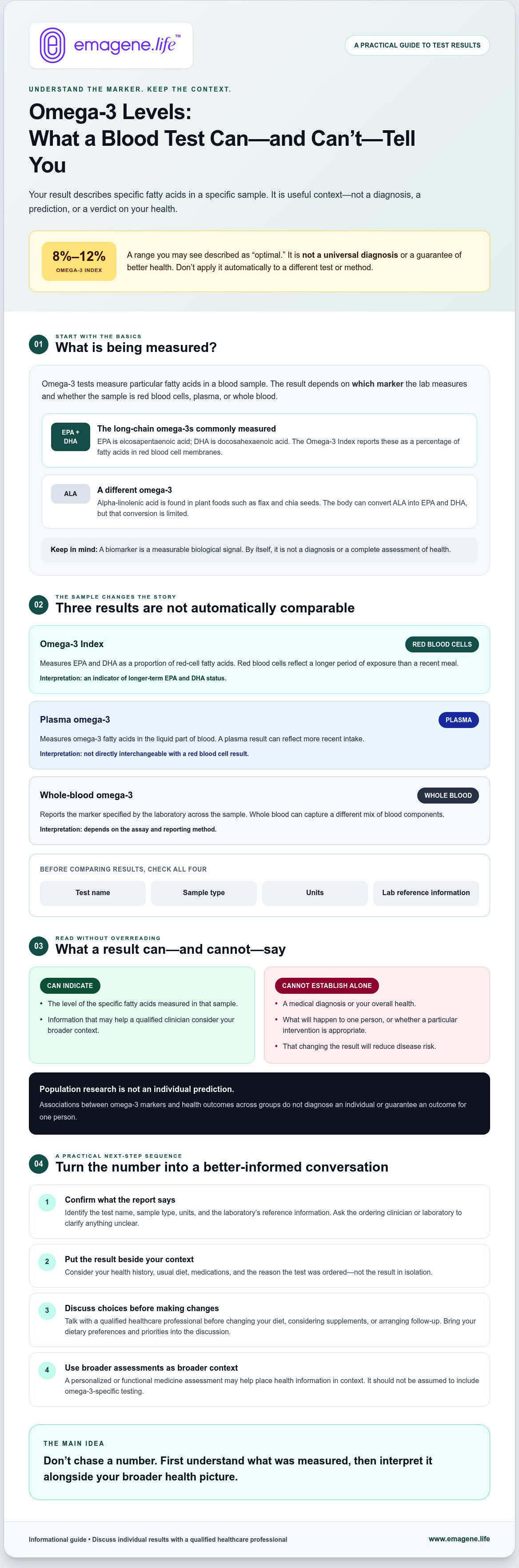
Your result makes more sense once you know what was measured. The Omega-3 Index estimates EPA and DHA in red blood cell membranes, while a plasma test can reflect more recent intake. Those results aren’t interchangeable, and neither tells the whole story on its own.
This guide explains what omega 3 levels measure, how to read common results and ranges, and what test limitations to keep in mind. You’ll also find questions to take to a qualified healthcare professional before changing your diet, considering supplements, or arranging follow-up. The goal isn’t to chase a number. It’s to use relevant evidence and your broader health context to make a more informed, individual decision.
Key Takeaways
- Learn what omega 3 levels can show about EPA and DHA, and why they’re only one part of a broader health picture.
- Before comparing results, check the test name, sample type, units, and laboratory reference information.
- Use a practical checklist to confirm your result, review relevant context, and discuss food or supplement decisions with a qualified healthcare professional.
- Bring your health history, dietary preferences, and priorities into the conversation instead of acting on a result alone.
- See how a functional medicine assessment may help place results in broader context, without assuming it includes omega-3-specific testing.
What Do Omega-3 Levels Measure in a Blood Test?
Omega-3 levels are measurements of particular fatty acids in a blood sample, not a complete assessment of health. The result depends on what the laboratory measures and whether it tests whole blood, plasma, or red blood cells. Start by checking the marker and sample type on the report.
A biomarker is a measurable biological signal. It is not, by itself, a diagnosis.
What are EPA, DHA, and the Omega-3 Index?
EPA (eicosapentaenoic acid) and DHA (docosahexaenoic acid) are long-chain omega-3 fatty acids commonly measured in blood tests. ALA (alpha-linolenic acid), found in plant foods such as flax and chia seeds, is a different omega-3. The body can convert ALA into EPA and DHA, but that conversion is limited. For an overview of these types and their roles, see Omega-3 fatty acids.
The Omega-3 Index measures EPA and DHA as a percentage of fatty acids in red blood cell membranes. Red blood cells reflect a longer period of exposure than a recent meal, so this marker is used as an indicator of longer-term EPA and DHA status. It is not interchangeable with every test labelled “omega-3.” Reference ranges and interpretations can vary, so check the laboratory’s explanation rather than treating one percentage as a universal target.
What can a blood result tell you, and what can it not?
A test can indicate the level of the specific fatty acids measured in the sample type used. For example, a plasma result and a red blood cell result may reflect different timeframes and cannot automatically be compared. Check the test name, units, sample type, and laboratory reference information. If these details aren’t clear, ask the ordering clinician or laboratory to explain them.
Research may find associations between omega-3 markers and health outcomes across groups. That doesn’t establish an individual diagnosis or predict what will happen to one person. A result alone can’t explain symptoms, confirm overall health, or show whether a particular intervention is appropriate. Interpret omega 3 levels alongside health history, diet, medications, and other relevant clinical information.
How to Interpret Omega-3 Test Results Without Overreading Them
A number has meaning only in the context of the test that produced it. Before interpreting omega 3 levels, check the test name, sample type, units, and laboratory reference information. A percentage from a red blood cell test, for example, isn’t directly comparable with a concentration reported for plasma.
Why do omega-3 results and ranges differ?
Laboratories may use different assays and report different markers. Sample type matters too: plasma can be influenced by recent intake, while red blood cell measures reflect a longer-term pattern. Whole blood results may capture a different mix of blood components. These distinctions affect what a result represents, so use the method notes and range supplied by the laboratory that performed your test.
Quick comparison
| Marker | Sample | What it represents | Key limitation |
|---|---|---|---|
| Omega-3 Index | Red blood cells | EPA and DHA as a proportion of red-cell fatty acids | Not directly interchangeable with plasma or whole-blood results |
| Plasma omega-3 | Plasma | Omega-3 fatty acids measured in the liquid part of blood | Can reflect recent intake |
| Whole-blood omega-3 | Whole blood | The marker specified by the laboratory across the sample | Interpretation depends on the assay and reporting method |
A reference range describes how a laboratory presents or compares results. It doesn’t automatically set a treatment target. Don’t apply a cutoff from one test to a different marker or method.
Does one omega-3 result diagnose a deficiency?
No single biomarker establishes a medical diagnosis on its own. A clinician can interpret the result alongside your health history, usual diet, medications, and the reason the test was ordered. Population research can reveal associations between markers and outcomes, but it can’t diagnose an individual or guarantee that changing a result will reduce disease risk.
If the result prompts questions about dietary intake, review reliable food and intake information, such as the NIH recommendations for omega-3 intake, with a qualified healthcare professional. For broader health context, you can also learn about Emagene Life’s functional medicine assessment. This is not a claim of omega-3-specific testing or treatment.
What to Do After an Omega-3 Test: A Practical Checklist
A test result is a starting point, not an instruction to change your diet or begin a supplement. Use this sequence to turn omega 3 levels into a more informed discussion with a qualified healthcare professional.
- Confirm the test. Check the full test name, sample type, units, date, and the laboratory’s reference notes. Ask which fatty acids or markers were measured if the report isn’t clear.
- Review your context. Note your usual eating pattern, including how often you eat oily fish, along with any supplements, medications, and health concerns. Share this information with the clinician reviewing your result.
- Discuss practical options. Ask whether the result changes any decision for you. Talk through food preferences and whether oily fish could fit your usual diet. Don’t assume a supplement is needed based on a number alone.
- Plan follow-up. If another test is being considered, clarify its purpose and timing with the clinician. Follow-up should answer a useful clinical question, not simply chase a different result.
How to prepare for a useful results discussion
Bring the complete laboratory report, not just a screenshot of the result. Include its units, reference information, and test date. Write down relevant dietary habits, supplements, medications, and health concerns so the discussion has useful context. Ask which marker was measured, what its limitations are, and whether the result changes a practical decision for you.
Food, supplements, and follow-up: keep decisions individualized
Oily fish is a general food source of EPA and DHA, but a test result alone doesn’t prescribe a particular food or amount. Discuss your dietary preferences with a qualified healthcare professional, especially if you avoid fish or have other health considerations. Supplement suitability can depend on individual circumstances and medications, so seek professional advice before starting one. Don’t assume a particular dose or retesting schedule applies to everyone.
If you’re seeking broader context for health concerns, learn about Emagene Life’s functional medicine assessment. It’s a broader assessment option, not a claim of omega-3-specific testing or treatment.
How a Personalized Health Assessment Can Put Omega-3 Levels in Context
A test result is one data point. A broader assessment can help a qualified healthcare professional consider it alongside your health history, dietary patterns, symptoms, medications, and current priorities. These factors provide context for a discussion; they don’t prove that a particular symptom is caused by omega-3 intake or that a result needs correction.
When broader health context may be useful
If health concerns persist, discuss them with an appropriately qualified healthcare professional rather than relying on omega 3 levels alone. Share what you eat, any symptoms you’re experiencing, relevant medical history, and the reason the test was ordered. Each detail may help shape the conversation, but none independently confirms an omega-3 problem. For related reading, explore this personalized health roadmap.
Questions to ask before making a change
Use the appointment to clarify what the result means for you, what the test can’t tell you, and which uncertainties remain. Ask whether food changes, a supplement, or repeat testing is appropriate in your specific situation. If a change is suggested, discuss its purpose, potential considerations, and how you and your clinician would assess whether it’s useful. Don’t assume a particular result calls for the same next step for everyone.
Emagene Life offers functional medicine assessments that explore health concerns and physiological imbalances as part of a broader personalized evaluation. The available information doesn’t confirm an omega-3-specific test or treatment, so an assessment shouldn’t be understood as either. To learn more about the service, read about a functional medicine assessment in Malaysia.
A broader assessment may be relevant if you’re looking for more context around your health priorities. Bring your test report and questions to the conversation, and confirm directly what an assessment includes. The aim is a more informed discussion, not a promised diagnosis or outcome.
Turn Your Results Into a Thoughtful Next Step
Omega 3 levels offer information about the specific fatty acids a test measures, not a complete verdict on health. Test markers, sample types, units, and laboratory guidance all matter, so interpret the report in context rather than chasing a number. A result alone doesn’t diagnose a condition or determine which food, supplement, or follow-up is right for you.
Bring your report, diet, medications, and health concerns to a qualified healthcare professional. Ask what the result means for your individual situation and which next steps, if any, are appropriate.
Emagene Life offers functional medicine assessments designed to explore underlying health concerns and physiological imbalances, as well as evidence-based longevity programs focused on long-term health. These services address the wider picture, not a confirmed omega-3-specific test or treatment. Explore Emagene Life’s functional medicine assessment if you’re considering a more comprehensive evaluation.
Use your result as a prompt for informed questions, then move forward with guidance tailored to you.
Frequently Asked Questions
What is a normal omega-3 level?
There’s no single result that defines “normal” for every person and every test. Interpretation depends on the marker measured, sample type, laboratory method, and reference information on your report. A range supplied for one test may not apply to another. Ask the clinician who ordered the test to explain your result in context. Don’t use an online cutoff as a diagnosis or treatment target.
How do I know if my omega-3 levels are low?
A blood test can report an omega-3-related marker, but whether a result is considered low depends on the assay and the laboratory’s guidance. Diet and symptoms alone can’t reliably establish a measured level. Review the complete report with a qualified clinician, including the test name, units, sample type, and relevant health context. Avoid starting a supplement solely because your result falls outside a range you found online.
What does the Omega-3 Index measure?
The Omega-3 Index generally refers to EPA and DHA measured in red blood cell membranes. Confirm the exact sample and reporting method with the laboratory that performed your test, since methods and conventions can differ. The index is a biomarker, not a complete assessment of health or a diagnosis. Ask your clinician what the result can tell you, what it can’t show, and how it applies to your situation.
Can I improve my omega-3 levels through food?
Food choices can affect omega-3 intake, but suitable options depend on your diet and health context. Oily fish is a commonly discussed source of EPA and DHA. Plant foods such as flax and chia provide ALA, which the body processes differently. A qualified healthcare professional or registered dietitian can help you consider your preferences and circumstances. Don’t assume a particular food change will produce a specific test result.
Should I take an omega-3 supplement if my levels are low?
A result alone doesn’t determine whether an omega-3 supplement is appropriate. The decision may depend on the test method, your usual diet, medical history, medications, and other individual factors. Discuss the full report with a qualified healthcare professional before starting or changing a supplement. Avoid relying on a universal dose or online target. If you have concerning symptoms, seek prompt medical advice rather than using a supplement as a substitute.
How often should omega-3 levels be tested?
There’s no single retesting interval that applies to everyone. Whether another test is useful depends on why the first was ordered, which marker was measured, and whether a new result could guide a clinical decision. Ask the ordering clinician whether follow-up is appropriate and when. Repeating a test without a clear purpose may produce more information without changing what you do next.


