

Personalized Nutrition Plans in Malaysia: How to Choose the Right Approach
What if the best nutrition plan isn’t the strictest one, but the one that fits your health priorities and the way you actually eat? Generic rules can feel disconnected from individual concerns, especially when everyday meals include familiar Malaysian favorites. A personalized nutrition plan Malaysia residents can sustain should reflect both personal health needs and real-life food choices.
Look beyond lists of “good” and “bad” foods. Useful guidance explains how your health priorities and individual assessment inform practical recommendations, while staying grounded in evidence and flexible enough for everyday life. To judge whether an approach is genuinely individualized, look for a clear link between your goals, your circumstances, and each recommendation.
This article explains what to look for in an assessment, how to judge whether recommendations are relevant and sustainable, and how to connect food choices to long-term wellbeing. Emagene Life’s Functional Medicine Assessment explores potential contributors to chronic health concerns and metabolic imbalances, then informs a personalized health roadmap focused on restoration and prevention.
Key Takeaways
- Recognize the difference between broad diet rules and guidance shaped around your needs, health context, and goals.
- Use a health assessment to clarify priorities and questions before deciding which nutrition changes to explore.
- Evaluate a personalized nutrition plan Malaysia approach by looking for clear reasoning, flexibility, and practical fit with everyday meals.
- Look for guidance that separates evidence-supported information from uncertainty instead of promising a one-size-fits-all answer.
- Turn a broad health goal into a practical next step by noting your concerns and identifying what you need to understand first.
What Makes a Personalized Nutrition Plan Different from Generic Diet Advice?
If broad diet rules haven’t felt right for you, that doesn’t mean you’ve failed. Advice can be difficult to use when it ignores your health priorities, daily routine, food preferences, or practical limits. A personalized nutrition plan Malaysia readers consider should connect food guidance to their circumstances, rather than simply offer a stricter set of rules.
A personalized nutrition plan is guidance shaped by an individual’s health needs, context, and goals, with recommendations explained in a way that can fit real life. Personalization means more than swapping ingredients or adjusting portion sizes. It involves understanding why a recommendation may be relevant, what it is intended to address, and how it could be adapted if circumstances change. It should not rely on rigid menus or promises of guaranteed results.
Which individual factors can shape nutrition guidance?
Relevant context may include your health priorities, usual routine, food preferences, and practical constraints, such as time for meal preparation or access to certain foods. Familiar meals and eating patterns matter too. Guidance that accounts for foods you actually eat can be easier to consider than a menu built around unfamiliar choices.
These factors don’t carry equal weight for everyone. One person may want to focus on a health concern, while another needs an approach that works around a busy routine or strong food preferences. Before a discussion, note what you typically eat, which parts of your routine feel difficult, and what you want to understand. That preparation helps focus the conversation, but it doesn’t replace an assessment of your individual needs.
Why can the same eating approach affect people differently?
People’s health contexts, routines, preferences, and responses can vary. A recommendation that suits one person may be impractical or unsuitable for another. That doesn’t mean a single food explains a complex health concern, or that every difference requires a specialized diet. Nutrition recommendations should be considered in light of the individual and reviewed against credible evidence.
General nutrition principles offer a broad starting point. Individualized guidance considers whether and how those principles apply to a person’s circumstances. For example, instead of labeling a familiar meal simply “good” or “bad,” consider how it fits your stated priorities and everyday eating pattern. The reasoning behind a recommendation matters as much as the recommendation itself.
When comparing approaches, look for a clear connection between your goals and the advice. A useful plan explains its reasoning, acknowledges uncertainty, and allows for practical adjustments. Personalization should make the guidance more relevant, not the promises more dramatic.
How a Health Assessment Can Inform a Personalized Nutrition Plan
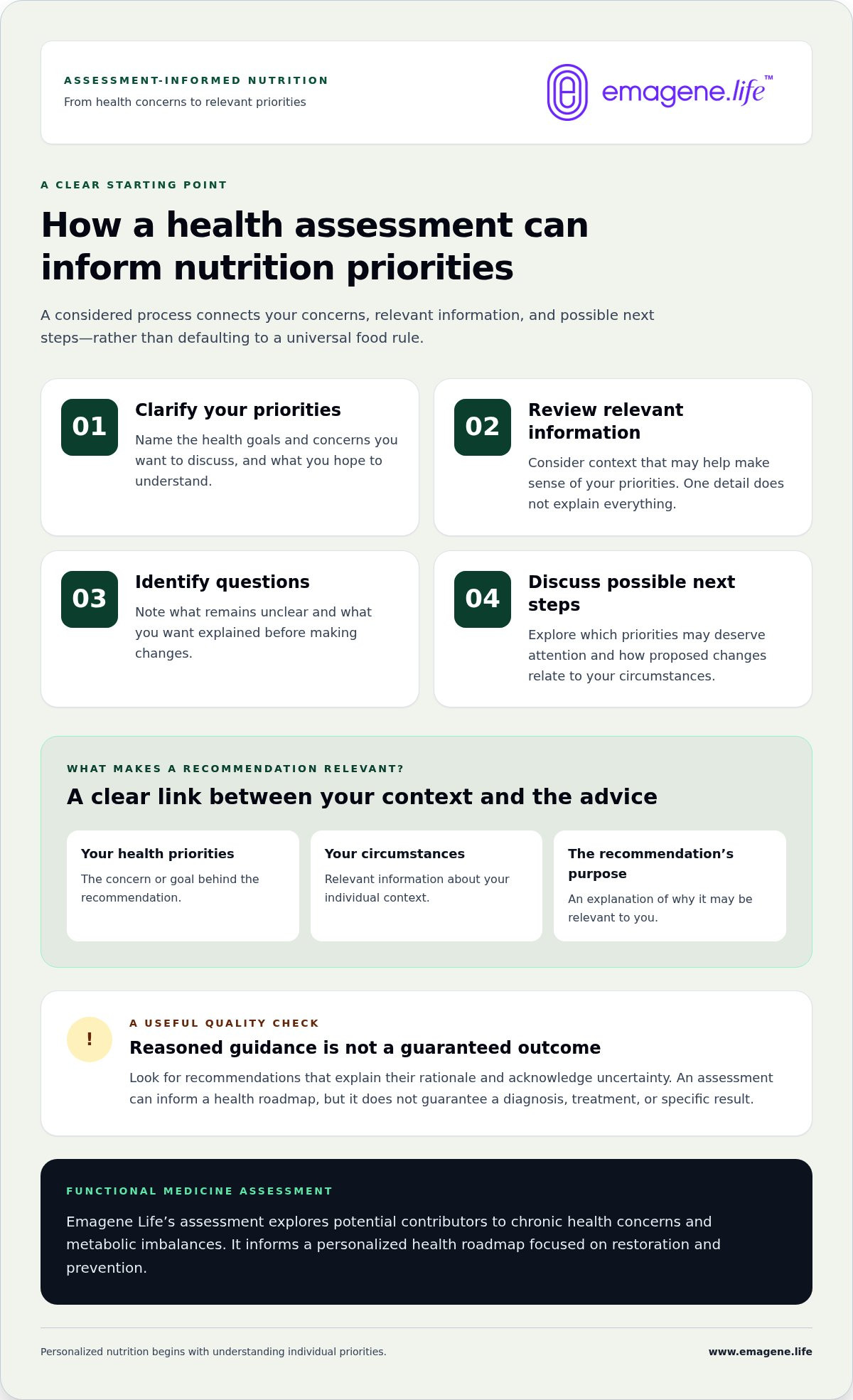
Choosing food changes before understanding the health context can lead to misplaced effort. An assessment offers a more considered starting point: clarify what matters to you, review relevant information, identify unanswered questions, and discuss possible next steps. This keeps nutrition priorities connected to your concerns instead of defaulting to a universal food rule.
Nutrition recommendations should have a clear rationale that links each proposed priority to the individual’s health context and goals. That rationale can help distinguish a considered recommendation from an unsupported claim. An assessment can inform a health roadmap, but it doesn’t guarantee a diagnosis, treatment, or specific result.
- Clarify your priorities. Name the health goals and concerns you want to discuss, and describe what you hope to understand.
- Review relevant information. Consider the context that may help make sense of those priorities, rather than assuming one detail explains everything.
- Identify questions. Note what remains unclear and what you’d like explained before making changes.
- Discuss possible next steps. Explore which priorities may deserve attention and how any proposed changes relate to your circumstances.
What questions should guide an assessment-informed approach?
Start with a few questions: What is my main health priority? What concern do I want help understanding? What information may be relevant? If a food-related change is suggested, can its purpose be explained in relation to my circumstances? A reasoned recommendation should make that connection clear and acknowledge uncertainty where it exists. A universal rule or dramatic promise without an individual rationale is not the same as assessment-informed guidance.
How does Emagene Life’s Functional Medicine Assessment fit?
Emagene Life’s Functional Medicine Assessment explores underlying contributors to chronic health concerns and metabolic imbalances. It informs a personalized health roadmap focused on restoration and prevention, helping establish relevant health priorities before deciding which nutrition questions or changes to consider. It doesn’t promise a particular diagnosis or nutrition outcome.
If you want a broader understanding of your health context before shaping your next steps, explore the Functional Medicine Assessment. For a personalized nutrition plan Malaysia approach, begin with clear priorities and questions, then assess whether proposed recommendations are relevant and well explained.
How to Evaluate a Personalized Nutrition Plan Before Committing
A polished menu isn’t proof that a plan is right for you. Before committing, assess four qualities: personal relevance, a clear rationale, flexibility, and realistic implementation. A personalized nutrition plan Malaysia readers explore should explain how its recommendations relate to their priorities, what supports them, and where uncertainty remains.
Does the plan explain why each recommendation fits you?
Look for a clear connection between your stated priorities and the suggested changes. If a plan recommends changing a meal, it should explain the purpose in terms you can understand, rather than presenting the change as a rule you must follow without question. A shared concern doesn’t mean everyone needs the same approach. Recommendations should reflect individual context, not assumptions based on a label or a single detail.
Can the plan work with your real life?
Consider whether recommendations account for your food preferences, routine, access to suitable foods, and time for preparation. A plan that depends on choices you can’t realistically maintain may be difficult to put into practice. Ask how priorities could be adjusted if your schedule, preferences, or circumstances change. Flexibility supports practical decision-making, but it can’t guarantee adherence or a particular result.
Credible guidance also separates evidence-supported information from uncertainty. Be cautious of guaranteed outcomes, extreme restrictions, or broad claims without appropriate support. Strong claims deserve clear explanations. If the reasoning is unclear, pause before treating a recommendation as necessary.
A useful plan connects each recommendation to your priorities, explains its rationale, acknowledges uncertainty, and fits your everyday life. Use this checklist when reviewing nutrition guidance:
- Relevance: Does the recommendation address a priority that matters to you?
- Rationale: Can you understand why it is being suggested?
- Evidence: Are supported conclusions distinguished from uncertainty?
- Flexibility: Can the approach adapt to your preferences and changing circumstances?
- Practicality: Can you see how it could fit your routine and food access?
Use your answers to identify what feels clear and what needs further discussion. If you want to establish health priorities before considering nutrition changes, Emagene Life’s Functional Medicine Assessment can inform an individualized health roadmap.
Your Next Step Toward Personalized Nutrition in Malaysia
Move from a broad goal to a focused next step. Start by defining what you want to understand, then gather context that can shape a meaningful conversation. You don’t need to arrive with a perfect food plan. The aim is to make sure your priorities come from your health concerns and real-life circumstances, not a trend or universal rule.
- Define your goal. Be specific about what you hope to address or learn, even if your goal is still broad.
- Note your concerns. Record the health questions you want to raise and any patterns you’ve noticed, without assuming a particular food is the cause.
- Organize relevant information. Gather health details that may help explain your context. Don’t assume a specific test is required.
- Seek a clear rationale. As you consider possible changes, look for an understandable connection between each priority and the recommendation.
What should you prepare before pursuing a personalized approach?
Write down your goals, relevant health concerns, typical routine, food preferences, and questions. Note which parts of daily eating feel easy to manage and which feel difficult. Organize any relevant health information you already have, but don’t treat this as a checklist of required tests. Preparation can help keep an assessment conversation focused on what matters to you.
How can you keep nutrition goals realistic and evidence-informed?
Favor next steps you understand, see as relevant, and can realistically consider within your routine. General nutrition education can help explain broad principles; individualized clinical recommendations require consideration of personal context and appropriate evidence. Keep those distinct. Avoid treating a universal menu as a personal prescription, and don’t expect a fixed timeline or guaranteed result. If circumstances shift, revisit whether your priorities still fit.
A personalized nutrition plan Malaysia readers can evaluate thoughtfully begins with clear goals, relevant context, and recommendations that make sense for their circumstances. Emagene Life’s Functional Medicine Assessment explores underlying contributors to chronic health concerns and metabolic imbalances, then informs a personalized health roadmap focused on restoration and prevention. Explore the Emagene Life Functional Medicine Assessment as a next step toward a more individualized health strategy.
Move Forward With a Clearer Health Strategy
Your next step doesn’t need to be a dramatic diet overhaul. Start with a question you want answered, then choose an approach that helps you make informed decisions at a pace that fits your life. A personalized nutrition plan Malaysia readers consider should support thoughtful choices, not pressure them into rigid rules or promises.
Keep your goals open to refinement. As your priorities become clearer, revisit which changes feel relevant, practical, and supported by a sound rationale. This gives you room to build a health strategy around your circumstances rather than trying to fit yourself into a predetermined plan.
Emagene Life’s Functional Medicine Assessment is available across Malaysia for those seeking an individualized starting point. Explore Emagene Life’s Functional Medicine Assessment and take a considered step toward a health strategy shaped around you.
Progress begins with a clearer question and a next step you can stand behind. Keep moving forward with curiosity and confidence.
Frequently Asked Questions
What is a personalized nutrition plan?
A personalized nutrition plan is guidance tailored to an individual’s circumstances rather than copied from a standard menu. It may account for goals, health context, food preferences, and everyday demands. For example, someone working rotating shifts may need a different meal structure from someone with regular hours. Personalization should clarify the reasoning behind recommendations, not promise that every detail has been uniquely tested or proven.
How does a personalized nutrition plan work?
A personalized nutrition plan Malaysia residents consider should translate a defined goal into practical food-related options, with an explanation of why those options may be relevant. The process may include discussing your priorities, considering your routine and preferences, and identifying changes that are realistic to explore. Clarify how changing circumstances could prompt a review instead of treating the first version as permanent.
Can a health assessment help guide nutrition choices?
Yes. A health assessment can put nutrition questions into context and clarify which concerns deserve further discussion. For example, if you suspect a particular food is linked to discomfort, an assessment can help frame that as a question rather than assume the food is the cause. Assessment findings can inform decisions, but they don’t automatically identify a dietary trigger or establish that a specific food change is appropriate.
Is a personalized nutrition plan better than a standard diet plan?
Not necessarily. A standard plan may offer a straightforward starting point for someone seeking general structure, while individualized guidance may be more relevant when personal health priorities, preferences, or practical needs matter. Neither format is automatically right for everyone. Consider whether the advice suits your purpose, whether its reasoning is clear, and whether it leaves room to adjust instead of insisting on one approach for every person.
How do I know if a nutrition plan is right for me?
A plan may be a better fit if you understand its purpose, can explain how it relates to your priorities, and can picture applying it in ordinary situations. Consider what happens during a busy workday, a shared family meal, or a change in routine. If recommendations feel confusing, excessively restrictive, or dependent on promises of guaranteed results, pause and seek a clearer explanation before proceeding.
Can a personalized nutrition plan support long-term health goals?
It may support long-term goals by helping you make food-related decisions that remain relevant as your needs and circumstances evolve. For instance, a change in work schedule or preferences may call for reconsidering how a goal is approached. Nutrition guidance is one part of a broader health picture, and it can’t guarantee a particular outcome. Keep goals flexible and review whether recommendations remain practical and appropriate.


