

What Is the Functional Medicine Approach? Principles, Diagnostics, and Longevity
Your routine blood panel came back "normal," yet persistent fatigue, brain fog, and digestive flare-ups tell an entirely different story. You already know that masking warning signs with another temporary prescription doesn't resolve why the breakdown occurred in the first place. Settling for reactive sick-care leaves you exhausted, stuck in limbo, and overwhelmed by conflicting advice. When conventional appointments offer few answers, understanding what is functional medicine approach to whole-body diagnostics becomes your most vital turning point.
Symptoms are not random failures; they are critical biological signals demanding investigation. Discover how the functional medicine approach identifies root causes through systems biology to optimize long-term healthspan. Ahead, we break down the foundational principles separating functional medicine from conventional medicine, explore what a data-driven diagnostic assessment reveals about hidden metabolic and gut imbalances, and map out your transition to proactive, lifelong vitality.
Key Takeaways
- Clarify what is functional medicine approach by discovering how systems biology targets upstream root causes instead of merely masking symptoms.
- Contrast reactive care with precision diagnostics to understand why conventional lab tests frequently miss early biological imbalances.
- Walk through the clinical assessment framework, mapping your personal health timeline across genetic antecedents, environmental triggers, and ongoing mediators.
- Connect deep cellular restoration directly to longevity, turning granular metabolic and hormonal data into a durable barrier against age-related decline.
What Is the Functional Medicine Approach to Health and Longevity?
Modern healthcare frequently manages disease only after cellular damage occurs. To redefine this dynamic, understanding what is functional medicine approach requires shifting focus from downstream symptoms to upstream root causes. Functional medicine operates as a science-backed, systems-oriented discipline designed to optimize long-term healthspan rather than simply suppressing acute pathology. Functional medicine treats the whole person by decoding interconnected physiological systems.
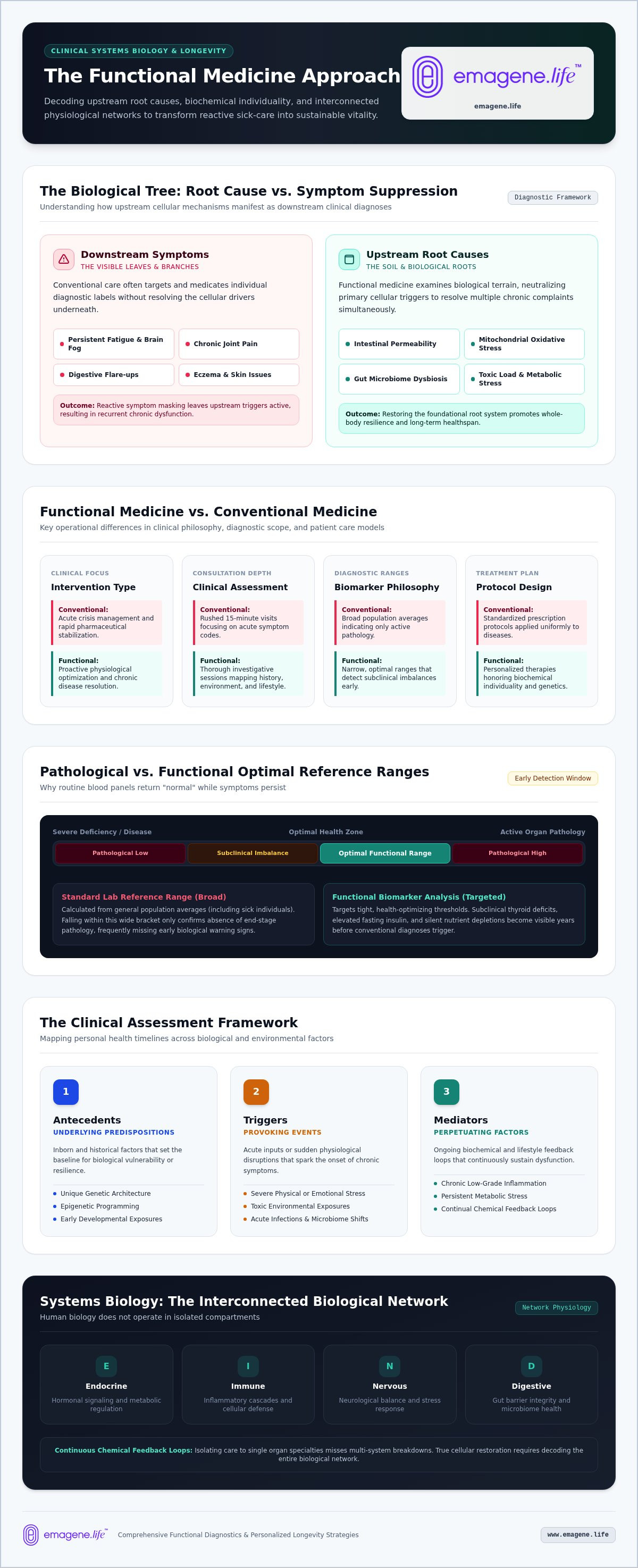
Consider the classic tree analogy. The visible leaves and branches represent downstream diagnostic labels like migraines, joint pain, or eczema. Conventional protocols often attempt to clip or medicate individual damaged leaves. The functional approach investigates the soil and root system; it examines cellular hydration, toxic load, and metabolic stress. By restoring the roots, the entire biological organism revitalizes naturally, replacing reactive sick-care with sustained physiological resilience.
The Core Philosophy: Upstream Root Causes Over Downstream Symptoms
Standard protocols often classify clinical symptoms without isolating their underlying mechanisms. Chronic inflammation, mitochondrial oxidative stress, and gut dysbiosis routinely manifest across diverse organ systems. A single driver, such as persistent intestinal permeability, can trigger joint pain, brain fog, and metabolic dysfunction simultaneously. Identifying and neutralizing these primary biological triggers clears multiple chronic complaints at once, delivering comprehensive resolution instead of lifelong symptom suppression.
Systems Biology: Viewing the Human Body as an Interconnected Network
Human biology does not operate in isolated compartments. The endocrine, immune, nervous, and digestive systems continually exchange chemical feedback loops. When healthcare fractures care across isolated organ specialties, subtle multi-system breakdowns get completely overlooked. Systems biology honors biochemical individuality. Your unique genetic architecture, microbiome composition, and environmental exposures mean no universal therapy works for every body. True biological restoration requires clinical precision matched to your distinct physiology.
Functional Medicine vs Conventional Medicine: Key Operational Differences
Conventional healthcare excels at acute crisis management. If you experience severe trauma or an acute cardiac event, hospital emergency protocols save lives. However, applying acute protocols to progressive chronic conditions produces diminishing returns. Understanding what is functional medicine approach highlights the fundamental clinical divide: conventional care treats reactive pathology, while functional medicine orchestrates proactive physiological optimization.
Acute Crisis Intervention Versus Chronic Disease Resolution
Rushed fifteen-minute consultations inevitably favor rapid pharmaceutical stabilization over root-cause discovery. Prescriptions manage symptoms, but they rarely reverse the cellular drivers fueling chronic exhaustion. As Functional medicine doctors demonstrate, resolving chronic disease requires thorough investigative consultations that trace systemic triggers, lifestyle factors, and environmental inputs over time.
Pathological Reference Ranges Versus Functional Optimal Biomarkers
Standard laboratory reference ranges rely on broad population averages, which inadvertently include data from individuals who are already unwell. Falling within these statistical goalposts simply means you lack active, diagnosable organ pathology. Functional analysis evaluates tighter, optimal biomarker ranges. Subclinical thyroid deficits, elevated fasting insulin, and silent nutrient depletions become visible years before they trigger conventional clinical diagnoses, allowing targeted, early intervention.
Standardized Disease Protocols Versus Biochemical Individuality
Conventional guidelines apply identical prescription treatments to anyone matching a specific diagnostic code. Your genetics, epigenetics, and daily environment are entirely unique, meaning uniform therapies cannot reliably restore diverse human biologies. Discovering what is functional medicine approach in practice centers on biochemical individuality. Partnering with Emagene Life provides the comprehensive functional diagnostics required to decode your individual metabolic markers and build a tailored longevity strategy.
The Clinical Methodology: How Functional Medicine Uncovers Hidden Imbalances
Clinical investigation replaces subjective guesswork with objective clarity. If you wonder what is functional medicine approach in actual practice, it unfolds through a rigorous four-phase continuum: comprehensive lifetime discovery, advanced cellular profiling, systems-matrix integration, and targeted therapeutic design. Every step aims directly at biological drivers.
Mapping the Lifetime Matrix: Antecedents, Triggers, and Mediators
Resolving chronic dysfunction demands understanding your entire health story across three critical dimensions:
- Antecedents: Congenital and genetic predispositions, birth history, and early environmental exposures that established your baseline vulnerability.
- Triggers: Provoking events that tipped your physiology into dysfunction, such as acute infections, heavy toxic exposures, psychological trauma, or severe antibiotic disruption.
- Mediators: Ongoing biochemical drivers that sustain illness daily, including persistent systemic inflammation, occult gut dysbiosis, and chronic nutrient depletion.
Advanced Diagnostic Profiling and Comprehensive Biomarker Panels
Precision diagnostics identify cellular degradation long before visible disease manifests. Functional testing evaluates the body through detailed biological panels:
- Comprehensive microbiome sequencing to quantify microbial balance, digestive capacity, and mucosal barrier integrity.
- Circadian hormone profiling measuring multi-point cortisol rhythms, DHEA, and bioavailable sex steroids.
- Metabolomic and organic acid testing to assess mitochondrial energy output, oxidative stress, and micronutrient reserves.
Synthesizing Biological Data into an Actionable Health Matrix
Isolated lab numbers don't heal people; contextualized biological roadmaps do. Functional specialists correlate objective lab metrics with your unique clinical presentation, eliminating conflicting opinions and delivering absolute therapeutic clarity. Deciding to explore a comprehensive functional medicine assessment establishes this critical baseline. Take decisive command of your vitality and schedule your clinical evaluation with Emagene Life.
Translating Functional Insights into Longevity and Sustainable Vitality
Escaping chronic illness is only the baseline. Understanding what is functional medicine approach reveals its ultimate purpose: transforming diagnostic data into an active blueprint for human longevity. By resolving subclinical cellular decay before irreversible tissue degeneration takes hold, functional care shifts your trajectory from gradual biological decline toward sustained peak performance.
From Symptom Resolution to Healthspan and Longevity Protocols
Lifespan simply counts your chronological years. Healthspan measures how many of those years you live with sharp mental acuity, physical strength, and boundless energy. Chronic systemic inflammation accelerates biological aging across every tissue bed. Neutralizing low-grade inflammatory fires protects telomere stability, preserves cellular machinery, and revitalizes mitochondrial density. Stable metabolic signaling restores steady energy output, replacing afternoon brain fog with crisp cognitive stamina.
Targeted Interventions: Precision Nutrition, Hormones, and Lifestyle
Translating biological data into longevity requires an interconnected therapeutic strategy tailored to your exact metabolic phenotype:
- Precision Nutrition: Therapeutic dietary protocols calibrated to repair gut barrier integrity, balance glycemic excursions, and eliminate individual immunogenic triggers.
- Hormone Optimization: Targeted endocrine rebalancing to restore optimal tissue regeneration, mood resilience, metabolic rate, and restorative recovery.
- Lifestyle Calibration: Evidence-backed modulations to sleep architecture, circadian light exposure, heart rate variability, and resistance conditioning.
Partnering for Continuous Optimization and Lifelong Health Mastery
Achieving biological resilience isn't a one-time medical event. Your physiology is dynamic, adapting continuously to age, career stress, and shifting environments. Sustained vitality requires periodic biomarker evaluation to refine interventions as your cellular needs evolve. Establishing a personalized health roadmap gives you transparent data to track measurable improvements over time. This continuous feedback loop clarifies what is functional medicine approach at its highest level: a collaborative partnership that gives you total, lasting mastery over your healthspan.
Take Command of Your Healthspan and Cellular Vitality
Living with unexplained fatigue, erratic digestion, or persistent brain fog isn't an unavoidable consequence of aging. True wellness is never merely the absence of acute pathology; it's the daily presence of peak biological vigor. Ultimately, understanding what is functional medicine approach equips you to replace guesswork with undeniable clinical data, decoding the exact cellular, hormonal, and metabolic mechanisms that dictate your performance.
You don't have to navigate chronic symptoms in isolation or settle for broad laboratory averages that overlook subclinical dysfunction. As a dedicated national center serving clients across Malaysia, Emagene Life delivers comprehensive functional diagnostic evaluations and specialized clinical longevity protocols tailored to your unique biochemical blueprint.
Your path to sustained physical stamina and cognitive clarity begins with investigative precision. Stop tolerating downstream warnings and step forward into active mastery over your biology. Begin Your Functional Medicine Assessment today and secure your long-term vitality.
Frequently Asked Questions
Is the functional medicine approach scientifically validated?
Yes, the functional medicine model is grounded in peer-reviewed systems biology, clinical biochemistry, and epigenetics. Leading global medical institutions apply these principles to investigate complex chronic illnesses. Rather than inventing novel biology, it applies established scientific discoveries regarding microbiome health, mitochondrial dynamics, and chronic inflammation to clinical practice. This evidence-based framework tracks how environmental inputs alter cellular expression, ensuring every intervention rests on verifiable physiological mechanisms.
How does a functional medicine assessment differ from an annual health screening?
Standard annual screenings search primarily for established diseases, whereas a functional assessment investigates upstream biological drivers before permanent tissue damage occurs. Routine checks confirm whether you fit broad population averages or face immediate acute crises. In contrast, evaluating what is functional medicine approach in clinical testing reveals deeper systemic metrics. Advanced diagnostics evaluate hormonal balance, gut barrier integrity, and cellular energy pathways to create a proactive, personalized optimization roadmap.
Can functional medicine help if my conventional lab tests are normal?
Absolutely. Conventional laboratory reference ranges represent broad statistical population averages designed to catch active pathology rather than optimal performance. You can struggle with debilitating fatigue, cognitive fog, or digestive issues while your standard labs appear completely normal. Functional medicine analyzes tighter, optimal biomarker ranges. By uncovering subclinical nutrient depletions, hidden gut dysbiosis, and early metabolic shifts, practitioners identify and resolve the root drivers behind your daily symptoms.
What health conditions benefit most from the functional medicine approach?
Multi-factorial, chronic health conditions benefit the most. Patients struggling with autoimmune reactivity, persistent gut dysbiosis, metabolic dysfunction, and unyielding chronic fatigue experience significant improvements. Applying what is functional medicine approach provides the greatest clinical leverage for interconnected disorders that conventional medicine divides across separate specialties. If your condition involves chronic systemic inflammation, hormonal imbalance, or toxic overload, functional care provides the unified framework required to restore cellular function.
Does functional medicine replace my primary care physician or specialist?
No. Functional medicine complements conventional care rather than replacing it. Traditional medicine remains essential for acute emergencies, trauma triage, and surgical procedures. Functional practitioners partner with your broader care network to resolve the underlying cellular mechanisms driving ongoing illness. This collaborative model ensures you remain fully protected during acute health crises while actively rebuilding your metabolic resilience, hormonal balance, and long-term healthspan.
How long does it typically take to see results with functional medicine?
Initial symptomatic relief often begins within four to eight weeks as systemic inflammation drops and digestive burdens lift. However, complete cellular regeneration, hormonal recalibration, and gut lining restoration usually require three to twelve months of consistent protocol adherence. Rebuilding biological resilience isn't an overnight pharmaceutical suppression. It's an active, progressive physiological repair process determined by your clinical starting point, protocol compliance, and unique biochemical individuality.


