

Functional Medicine Assessment in Malaysia: How to Compare Your Options
What makes an assessment valuable is not simply how much data it gathers, but whether that information helps you decide what to focus on next. If you’re searching for “functional medicine assessment Malaysia,” you may be comparing a personalized evaluation with a standard health check and looking for more than a set of results. You want to understand how the findings relate to your health priorities.
Emagene Life’s Functional Medicine Assessment is a detailed diagnostic evaluation designed to explore underlying health issues and metabolic imbalances. It provides a starting point for individualized planning, with a personalized health roadmap focused on restoration and prevention. The assessment does not promise a particular finding or outcome.
This guide explains what a functional medicine assessment aims to clarify, how its approach differs from a standard health check, and why thoughtful interpretation matters more than test volume. It also covers practical ways to compare approaches and prepare for a discussion about your health priorities.
Key Takeaways
- A functional medicine assessment Malaysia readers compare should consider broader health patterns and possible contributing factors, not just a snapshot of symptoms.
- Useful health planning connects personal context and relevant information with clear explanations and prioritized next steps.
- Compare approaches by how they consider your history and goals, choose relevant information, explain findings, and support follow-through.
- More tests do not automatically make an assessment more useful. Focus on whether the information is relevant and clearly interpreted.
- Emagene Life’s Functional Medicine Assessment explores underlying health issues and metabolic imbalances as a foundation for a personalized health roadmap.
What Does a Functional Medicine Assessment in Malaysia Aim to Clarify?
If a symptom-by-symptom snapshot leaves you wondering how different aspects of your health may connect, a broader evaluation can offer context. A functional medicine assessment in Malaysia is designed to explore health patterns and potential contributing factors rather than treating one result as the whole story. It can inform health planning, but it does not guarantee a diagnosis, explain every concern, or promise a particular outcome.
Personal history and goals help put health information into perspective. The same finding may mean different things depending on symptoms, health history, daily habits, and priorities. For example, a result may be more relevant when considered alongside a concern you want to address than when viewed on its own. Functional medicine uses an individualized, systems-oriented perspective. What is Functional Medicine? offers a general overview of its principles and classification.
How is an assessment different from a single test?
A test provides a specific piece of information. An assessment is a broader evaluation that considers relevant findings in context and explores what they may mean for an individual. One isolated result may not explain a complex concern, and adding more tests does not automatically make an evaluation more useful. The key questions are whether the information is relevant to your priorities and whether its meaning is explained clearly.
Who may consider a personalized health assessment?
People with persistent or complex health concerns may want a clearer view of possible contributing factors, especially when symptoms or findings are difficult to connect. Others may be interested in proactive health planning even when they feel well. In either case, an assessment can help organize questions and clarify priorities for discussion. It is not a substitute for urgent care. Seek appropriate medical attention for urgent or severe symptoms.
Before an evaluation, identify what you want to understand. Write down your main concerns, how they affect daily life, and the questions you want to discuss. This helps keep the conversation focused on information that may support useful decisions, rather than collecting data without a clear purpose.
How Does Functional Medicine Turn Health Information Into a Roadmap?
Information becomes useful when it helps clarify what deserves attention and why. A functional medicine assessment in Malaysia should connect personal context with relevant information, careful interpretation, and prioritized next steps. Health history, lifestyle context, and other health information are examples of factors that may inform an evaluation. The information considered depends on the individual.
A clear reasoning process keeps the focus on meaning, not data volume:
- Context: Clarify your concerns, relevant history, and goals.
- Relevance: Consider how the available information relates to those priorities.
- Interpretation: Review findings in context rather than treating them as standalone answers.
- Priorities: Identify reasonable next steps and explain the thinking behind them.
Recommendations should be evidence-informed and considered in an appropriate clinical context. A roadmap can support decision-making, but it is not a diagnosis or a promise of a specific result.
Why personal context changes how findings are understood
The same result may have different implications for different people. Symptoms, health history, daily routines, and personal goals can shape which questions matter and how information is interpreted. A single biomarker, for example, should not be treated as a standalone explanation for someone’s experience. Context helps guide discussion without assuming a diagnosis from one detail.
What makes a health roadmap practical?
A practical roadmap explains priorities and the reasoning behind them. It helps distinguish what may need attention first from what can be discussed later, while keeping proposed steps relevant to the individual’s circumstances. Generic checklists can overlook personal needs. So can reports that list findings without explaining why they matter. The aim is a clearer basis for discussion, not a fixed timeline or guaranteed result.
To prepare, write down the questions you most want answered and the health goals that matter to you. After the evaluation, consider whether the guidance connects findings to understandable priorities. Explore Emagene Life’s functional medicine approach as a starting point for individualized health planning.
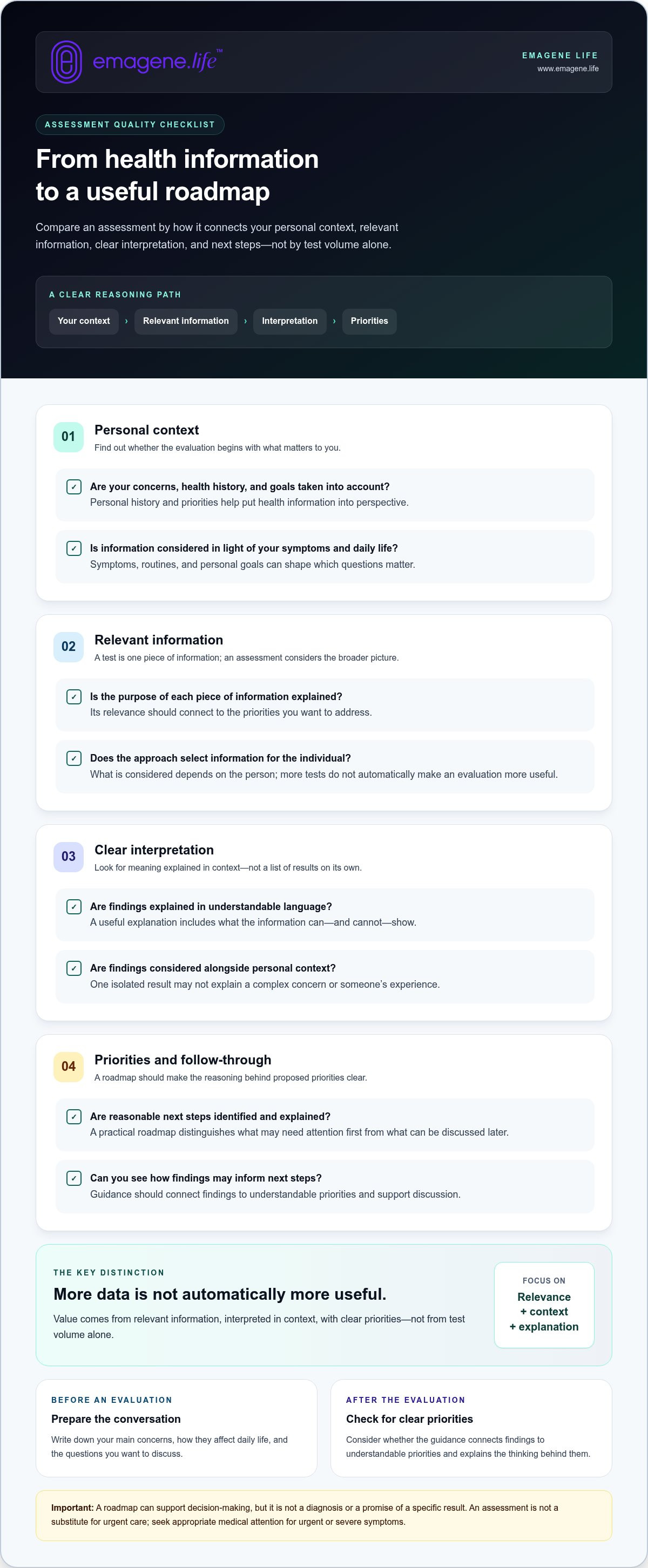
How to Compare Functional Medicine Assessment Approaches
A useful comparison looks beyond the number of tests or the length of a report. When comparing functional medicine assessments in Malaysia, consider whether personal context, relevant information, interpretation, and follow-through connect. Use these criteria to understand how an approach moves from evaluation to proposed priorities.
Context: Does the approach take your concerns, health history, and goals into account, rather than treating you as a set of results?
Relevance: Is the purpose of each piece of information explained in relation to your priorities?
Interpretation: Are findings explained in understandable language, including what they can and cannot show?
Follow-through: Does the assessment explain how findings may inform next steps and how questions or changing priorities can be addressed?
More tests do not automatically mean a more complete or useful assessment. Each investigation should have a clear purpose, and findings should be interpreted in context. A sound rationale links what is being evaluated to what the information may clarify, then to priorities that make sense for the individual. A large amount of data without explanation can leave you with more questions, not a more usable plan.
Which questions reveal whether an assessment is individualized?
Consider whether the approach accounts for your specific concerns, history, and goals. Is the purpose of each recommended investigation explained? Can findings be connected to relevant next steps in language you understand? These questions help distinguish an individualized evaluation from a generic checklist. Look for a clear link between what matters to you, what information is considered, and why a particular priority is suggested.
How to assess evidence, limits, and follow-through
Useful explanations make room for uncertainty. Consider how strongly a finding supports a conclusion and what it cannot establish on its own. A health roadmap can organize priorities and support decision-making, but it cannot guarantee a diagnosis or improvement. Follow-through matters, too: look for a clear way to discuss questions about findings and proposed next steps. The details of an assessment may vary with the individual.
Use these criteria to compare what an assessment is designed to clarify and how its findings may guide individualized planning. Explore Emagene Life's functional medicine assessment as a starting point for a personalized health roadmap.
Emagene Life's Functional Medicine Assessment: From Evaluation to Next Steps
For anyone considering a functional medicine assessment in Malaysia, an important question is what the evaluation is designed to support. Emagene Life’s Functional Medicine Assessment is a detailed diagnostic evaluation designed to explore underlying health issues and metabolic imbalances. It provides a foundation for personalized health planning, without promising a particular finding, diagnosis, or outcome.
What the Emagene Life assessment is designed to support
The assessment explores relevant health information as part of a broader view of individual needs. Its findings provide a foundation for a personalized health roadmap focused on restoration and prevention. The roadmap supports planning rather than offering a preset checklist or a guarantee of improvement. Its value lies in connecting an individualized evaluation with priorities that can be discussed and considered in context.
The assessment focuses on your health priorities and what the information may mean for your situation, rather than promising a guaranteed answer. A thorough evaluation can help frame questions and guide planning, while interpretation still has limits. The assessment supports decision-making; it does not replace appropriate medical care or ensure that every concern will have a definitive explanation.
What to do after deciding an assessment fits your goals
Prepare for a focused discussion. Write down the concerns or goals you most want to address, along with questions you hope the assessment can help clarify. Organize relevant health history and existing information that may provide useful context. This preparation helps you communicate what matters without assuming that any particular test or process is part of the evaluation.
- Note your main health questions and the changes you want to understand.
- Gather relevant health history and existing information for discussion.
- Consider what a useful next step would look like for your priorities.
For a broader perspective on how individualized planning relates to longevity, explore Personalized Health Roadmap Malaysia: The Definitive Guide to Longevity 2026. A clear starting point is knowing what you want the evaluation to help you understand. Explore a personalized functional medicine assessment with Emagene Life.
Make Your Next Health Decision With Clarity
Start with a useful question: What do you want your health information to help you understand? Write down the concern or goal that matters most, then use it to assess whether an evaluation fits your priorities. A useful approach supports thoughtful discussion; it does not simply promise more data or certainty.
If you’re comparing options for a functional medicine assessment in Malaysia, Emagene Life’s work focuses on functional medicine and longevity. Its assessment is designed to inform a personalized health roadmap and help frame individual priorities. Consider what meaningful, practical guidance would look like for your circumstances.
Move forward at your own pace and choose an approach that fits the questions you want to address. Explore Emagene Life’s functional medicine assessment as a starting point for individualized health planning.
Frequently Asked Questions
What does a functional medicine assessment include?
A functional medicine assessment is a detailed diagnostic evaluation designed to explore underlying health issues and metabolic imbalances. The information considered depends on the individual, so assessments may not all involve the same tests or procedures. Emagene Life uses its assessment as a foundation for personalized health planning. Before your assessment, identify the concerns you want to discuss so the evaluation can be considered in relation to your priorities.
Is a functional medicine assessment the same as a health screening?
No. A standard health screening commonly focuses on checking selected health indicators, while a functional medicine assessment aims to consider health concerns and possible contributing factors more broadly. Their purpose and scope can differ, so they are not automatically interchangeable. A screening may suit routine checks, while a functional medicine assessment may suit someone seeking an individualized evaluation and discussion of health priorities.
Can a functional medicine assessment identify the cause of ongoing symptoms?
It may help explore factors that could be relevant to ongoing symptoms, but it cannot promise to identify a single cause. Symptoms can have multiple explanations, and findings need careful interpretation alongside a person’s wider health circumstances. If symptoms persist, continue appropriate medical care and share relevant previous evaluations when available. Treat the assessment as a way to inform discussion, not as proof of a diagnosis.
How do I know whether a functional medicine assessment is right for me?
A functional medicine assessment Malaysia readers consider may be relevant if they want an individualized discussion of persistent concerns, complex health questions, or proactive wellness goals. Start by defining what you hope to understand and whether a broader evaluation fits that purpose. If you have urgent or severe symptoms, seek appropriate medical attention rather than relying on a planned assessment to address an immediate need.
Does a functional medicine assessment guarantee a diagnosis or treatment outcome?
No. An assessment can inform health planning and decision-making, but it cannot guarantee a diagnosis, explain every symptom, or ensure a particular treatment result. Findings may clarify useful questions without providing a definitive answer. Be cautious of promises of certainty or guaranteed improvement. A sound discussion distinguishes what the available information suggests from what remains uncertain and keeps decisions grounded in appropriate clinical context.
What should I prepare before a functional medicine assessment?
Prepare a concise account of your main concerns, when they began, and how they affect daily life. Gather relevant health history and existing information, such as previous reports or a current medication list. You do not need to interpret the documents yourself. Note your key questions and goals, too, so the discussion can focus on what matters most to you. Explore Emagene Life’s Functional Medicine Assessment.


