

How to Get Certified as a Functional Medicine Doctor
A functional medicine certificate can deepen your clinical framework, but it isn’t a medical license. If you’re asking how to become a certified functional medicine doctor, start by separating professional licensure from additional training. They serve different purposes, and confusing them can lead to assumptions about what you’re qualified to do.
The right pathway depends first on your existing professional qualifications and intended role. Certification may demonstrate further study in functional medicine, but it doesn’t expand your legal scope of practice or replace the license required for clinical work. Before comparing programs, identify what you want to learn and what professional requirements apply to your work.
This guide explains the distinction, outlines a practical way to compare education options, and highlights what to review before applying a functional medicine framework in practice. In Malaysia, check current professional requirements with the relevant official regulator. With that foundation, you can assess Emagene Life’s Functional Medicine Academy and Functional Medicine Training as options for further learning.
Key Takeaways
- Distinguish a medical qualification and professional registration from a course certificate or functional medicine certification. Each serves a different purpose.
- Plan how to become a certified functional medicine doctor by matching your training sequence to your existing qualifications and intended professional role.
- Compare education options by reviewing eligibility, assessment methods, the credential issuer, renewal terms, and relevance to your goals.
- Before applying functional medicine training in practice, verify current Malaysian requirements and understand the limits of your professional scope.
- Explore Emagene Life’s Functional Medicine Academy and Functional Medicine Training as options for deepening your knowledge.
What Does It Mean to Become a Certified Functional Medicine Doctor?
Functional medicine certification is additional education or professional recognition. It isn’t automatically a medical license. The term “functional medicine doctor” generally refers to a medical doctor who has pursued further training in functional medicine, not someone who became a doctor through a certificate program.
A medical qualification establishes academic training, professional registration relates to recognition by the relevant profession, a course certificate records completion of education, and legal authorization determines whether and how someone may practice. These credentials are not interchangeable. Functional medicine takes a systems-based approach to health. The Functional Medicine Wikipedia overview provides general context on its principles, history, and criticisms.
How Is Functional Medicine Certification Different From a Medical License?
Professional registration and a functional medicine credential serve different purposes. Registration relates to a person’s professional authority under applicable rules; a functional medicine credential reflects additional study or recognition in a particular framework. A certificate alone shouldn’t be treated as proof of specialist status, prescribing rights, or authority to practice independently.
In Malaysia, practice requirements depend on the applicable professional rules and the practitioner’s primary qualification. Before applying a functional medicine framework in clinical work, verify current requirements and scope-of-practice guidance through the relevant Malaysian authority. Training can deepen knowledge, but it doesn’t change the boundaries of a professional role.
Who Can Pursue Functional Medicine Training?
Training may interest physicians and other qualified health professionals who want to add a systems-based perspective to their existing work. Wellness professionals may also pursue learning for roles that don’t involve practicing medicine. Eligibility varies by program, so review the published admission criteria before applying.
Check whether a program is designed for your professional background, what completion represents, and whether it includes an assessment or credential. Don’t assume that a certificate intended for one audience carries the same meaning for another. A nonphysician may gain functional medicine knowledge through education, but that training doesn’t confer a medical degree or make them a medical doctor.
If you’re researching how to become a certified functional medicine doctor, begin with your current qualification and intended role. Then distinguish the education you want from the authority you need to practice. This makes your next training decision clearer and helps prevent a certificate from being mistaken for clinical authorization.
How to Build a Functional Medicine Training and Certification Pathway
A clear pathway starts with your current qualifications and ends with a careful review of the credential you’re pursuing. The right sequence depends on whether you’re a physician, another qualified health professional, or a wellness professional, as well as the role you intend to perform. If you’re exploring how to become a certified functional medicine doctor, use these stages to compare options against your background rather than assuming every program leads to the same outcome.
Establish your professional foundation, build core knowledge, pursue relevant clinical education, then review the credential’s criteria. This sequence supports informed decisions, but it doesn’t promise a particular credential or authorize a particular type of practice.
Which Training Stages Should You Consider?
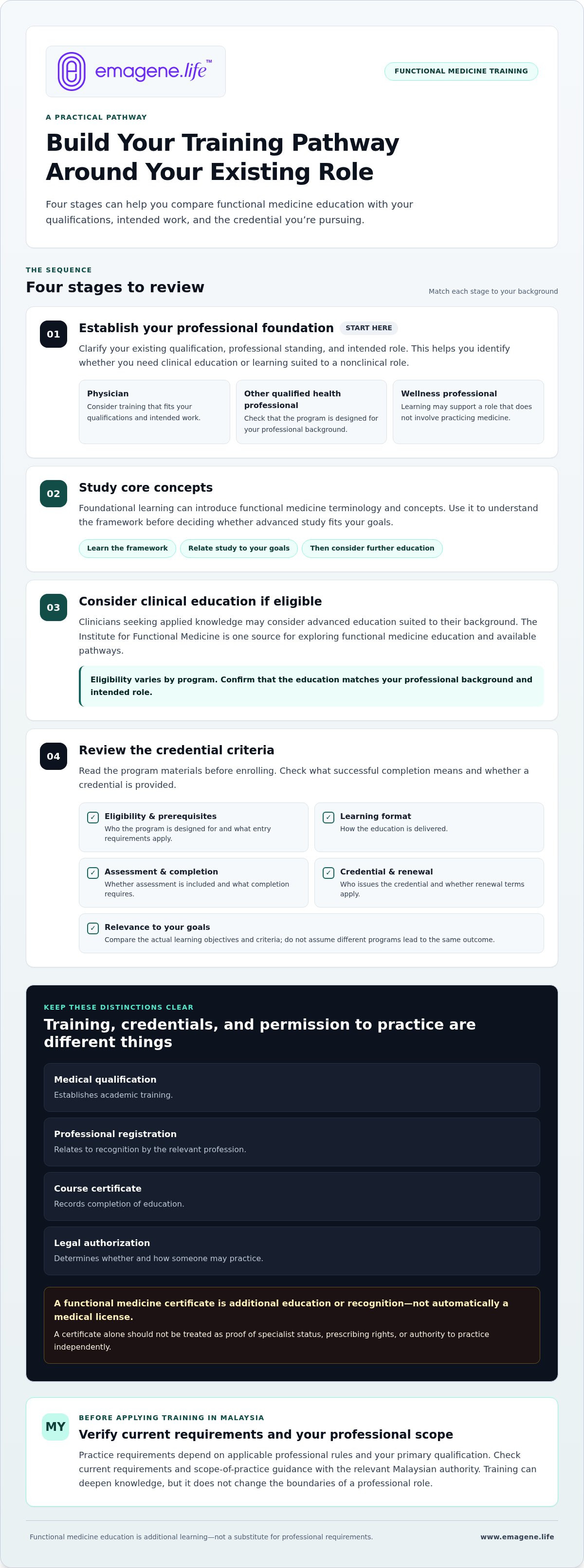
- Establish your professional foundation. Clarify your existing qualification, professional standing, and intended role. This helps you identify whether you need clinical education or knowledge suited to a nonclinical role.
- Study core concepts. Foundational learning can introduce functional medicine terminology and concepts. Use this stage to understand the framework before deciding whether more advanced study fits your goals.
- Pursue clinical education if eligible. Clinicians seeking applied knowledge may consider advanced education suited to their background. The Institute for Functional Medicine is one source for exploring functional medicine education and its available pathways.
- Review the credential criteria. Read the program materials before enrolling. Check prerequisites, learning format, assessment, and completion requirements. Confirm what credential, if any, successful completion provides.
Functional medicine and lifestyle medicine may both address health behaviors and broader influences on health, but they’re distinct fields with their own approaches and professional education. Don’t assume a lifestyle medicine course meets the requirements of a functional medicine credential, or vice versa. Compare the actual learning objectives and credential criteria.
How Do Certification Requirements Vary?
“Certificate” can describe different outcomes. A course-completion certificate may document that a learner finished a course. A formal certification process may have separate eligibility rules, required coursework, examinations, or renewal expectations. Requirements vary by credential, so don’t treat one program’s criteria as universal. Confirm details in the credential issuer’s current materials.
For a practical next step, compare your goals with Emagene Life’s functional medicine education, including its Functional Medicine Academy and Functional Medicine Training. Consider further education as a way to deepen your knowledge, while keeping professional requirements and credential outcomes distinct.
How to Evaluate Credentials, Clinical Readiness, and Malaysian Requirements
A credential is useful only when you understand what it represents. Review the qualification, issuer, and stated outcome, then consider how they relate to your professional role. A training credential alone should never be presented as authorization to practice medicine.
| Credential | What it represents | What to verify |
|---|---|---|
| Medical qualification | Academic education in medicine. | The qualification and its relevance to your intended role. |
| Professional registration | Recognition within a profession under applicable requirements. | Current status and relevant Malaysian requirements through official sources. |
| Course certificate | Completion of a specific course or learning activity. | What completion means and whether an assessment is involved. |
| Certification | A credential awarded under an issuer’s defined process. | Published eligibility, assessment, scope, and renewal standards. |
What Should You Check Before Selecting a Credential?
Look beyond the credential’s title. Identify the issuing organization and find its published standards. Check whether the program is intended for your professional background, which competencies it assesses, and whether it has ongoing requirements. Distinguish documented program details from broad marketing claims about recognition. If the materials don’t explain what the credential signifies, don’t assume it carries a specific professional status.
- Eligibility: What qualifications or experience are required?
- Assessment: How is learning or competence evaluated?
- Scope: What does the credential recognize, and what does it not authorize?
- Renewal: Are there continuing or renewal expectations?
- Issuer: Who awards the credential, and where are its standards published?
What Does Clinical Readiness Require Beyond a Certificate?
Clinical readiness rests on more than course completion. Existing professional education, sound clinical judgment, and practice within the applicable scope all matter. A responsible practitioner evaluates evidence, considers patient safety, and recognizes when referral or collaboration is appropriate. Functional medicine education can add perspective, but it doesn’t replace conventional diagnosis or urgent assessment when needed.
If you’re exploring how to become a certified functional medicine doctor in Malaysia, verify current professional requirements with the relevant official regulator for your profession. Don’t infer authorization from a course title or certification alone. Emagene Life offers Functional Medicine Training as an education-focused way to deepen your functional medicine knowledge, separate from professional registration and scope requirements.
Where Emagene Life's Functional Medicine Training Fits in Your Next Steps
Once you’ve clarified your qualifications, intended role, and relevant credentials, consider which education may deepen your understanding of functional medicine. Emagene Life offers the Functional Medicine Academy and Functional Medicine Training as options for continued learning. They can fit into a professional development plan, but they don’t replace the qualifications or professional requirements attached to your role.
How Can Emagene Life's Training Fit Your Professional Development?
Functional medicine education can help learners explore a broader, systems-oriented perspective on health and build knowledge around root-cause thinking. The value of further study depends on how it aligns with your background and how responsibly you apply what you learn. For clinicians, that means keeping clinical judgment, evidence appraisal, and patient safety central. For other learners, it means staying clear about the boundaries of their professional role.
As you compare options, consider how the program information relates to your learning goals. Keep education outcomes separate from professional recognition or qualification for a specific clinical role. Review credential details and Malaysian professional requirements through the relevant official sources before making a commitment.
What Is a Responsible Next Step After Reading?
Turn your research into a simple plan. Write down your current qualifications, the knowledge you want to develop, and the role you intend to pursue. Then identify the learning that fits those aims. A physician seeking additional clinical insight may have different needs from a health professional or wellness practitioner pursuing broader functional medicine knowledge. Choose education that matches your starting point and intended scope, not simply the option with the most prominent credential label.
If you’re still asking how to become a certified functional medicine doctor, start with a clear distinction: education can deepen expertise, while professional authorization depends on applicable requirements. Review those requirements before enrolling, and assess training according to its published terms. This supports continued learning and responsible practice without assuming a course will provide an outcome it doesn’t promise.
Explore Emagene Life’s functional medicine education to consider how further learning fits your professional development goals.
Turn Your Learning Goals Into a Clear Next Step
Professional development is most effective when guided by a defined purpose. Before choosing your next learning step, consider the knowledge you want to build and how it fits your current qualifications and future role. There’s no single pathway that suits every professional. Your plan should reflect your starting point and the requirements that apply to your work in Malaysia.
Set a learning goal, review the relevant credential information, and verify professional requirements with official sources before committing. That discipline keeps education aligned with responsible practice and gives each step a clear purpose.
Emagene Life offers the Functional Medicine Academy and Functional Medicine Training. Explore Emagene Life’s Functional Medicine Academy and Training to consider how continued learning could support your professional development.
Build your knowledge with purpose, and let a clear understanding of your role guide what comes next.
Frequently Asked Questions
Is functional medicine certification the same as a medical license?
No. A medical license relates to legal authority to practice within a jurisdiction, while a functional medicine credential reflects education or recognition through a particular program. Completing a course may document study without meeting the requirements of a separate certification process. Before relying on any credential in Malaysia, check current professional requirements with the relevant official authority, including registration requirements for your profession.
Can a non-physician become a certified functional medicine doctor?
No. Functional medicine education doesn’t make someone a medical doctor or confer a medical qualification. Some programs may accept qualified health professionals from different backgrounds, but each sets its own entry criteria. A course may be designed for broader professional development rather than clinical practice. Describe your qualifications accurately, review the program’s published eligibility rules, and stay within the scope authorized for your profession.
Does functional medicine certification qualify someone to practice in Malaysia?
Certification alone shouldn’t be treated as permission to practice medicine in Malaysia. If you’re considering how to become a certified functional medicine doctor, first determine which professional requirements apply to your qualifications and intended clinical role, then verify them with official sources. Read the credential’s terms carefully: a course certificate, an assessed award, and a separate certification process may represent different achievements and shouldn’t be presented as equivalent.
How long does it take to become a certified functional medicine doctor?
There’s no single timeline for every pathway. Your starting qualification, program sequence, eligibility criteria, and assessment or completion requirements all affect how long additional study takes. To estimate your own timeline, list the stages required by the specific credential and compare them with its current published schedule. Keep that education timeline separate from any professional registration process that applies to your role.
Is online functional medicine training enough to earn certification?
Not necessarily. Online delivery describes a learning format, not the credential awarded. Check whether the program’s outcome is a course-completion certificate or a separate certification, and review its learning objectives, assessment method, and completion conditions. Finishing online lessons may document course participation, while another credential may require additional steps. Neither format, by itself, establishes professional registration or changes your authorized scope of practice.
How can I tell whether a functional medicine credential is credible?
Start with the issuing organization and look for clear, accessible standards. Review who the program is designed for, what it covers, how competence is assessed, and whether there are ongoing obligations. Compare those details with your existing qualifications and intended role. Treat broad claims of recognition cautiously unless the issuer explains what they mean, and verify any claimed practice rights through the appropriate Malaysian official source.


