

Functional Medicine Certification: Why It Matters
A course certificate can show that you completed training, but it doesn’t automatically show what you can do. That distinction is central to understanding functional medicine certification and deciding whether a credential reflects assessed learning or simply course participation.
The terms certification, qualification, membership, and course completion are often used side by side, yet they describe different things. Approval claims can add another layer of confusion. In Malaysia, consider what a credential actually demonstrates, who it’s designed for, and how it relates to your existing professional role. Certification alone doesn’t change the scope of practice attached to that role.
This article explains how training, certification, and professional recognition differ, and how to assess programs by their standards, prerequisites, assessment methods, and intended audience. You’ll also find a practical framework for choosing an appropriate next step in your education. Emagene Life offers Functional Medicine Academy and Functional Medicine Training for those exploring structured learning. Evaluate them as educational options, while keeping education distinct from accreditation or professional authorization.
Key Takeaways
- A functional medicine certification is most informative when you understand the standard it represents and how achievement is assessed.
- Compare program content carefully. Foundational concepts, coaching, and clinical application may feature differently across courses.
- Use a clear evaluation sequence: define your role, review entry requirements, verify the issuer, compare the curriculum, and assess practical learning.
- Clarify your learning goals and professional context before considering Functional Medicine Academy or Functional Medicine Training as your next step.
What Does Functional Medicine Certification Actually Mean?
A certification documents that a person completed training or met assessment criteria against a program’s stated standard. The word alone doesn’t tell you which of those happened, what was assessed, or who set the standard. To understand what a credential demonstrates, look beyond its title to the requirements behind it.
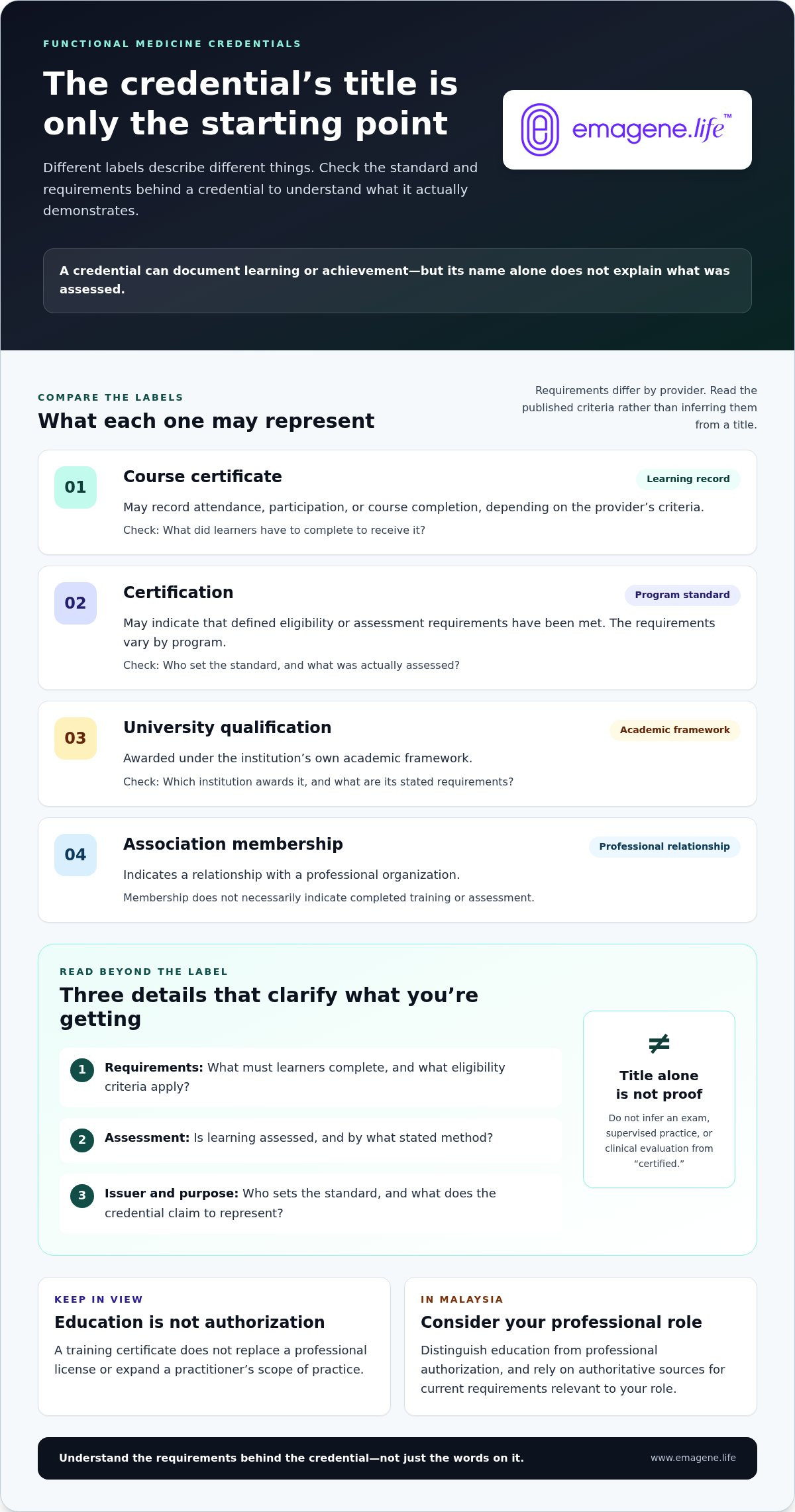
Labels matter. A course certificate may record completion. A certification may involve defined eligibility or assessment requirements, but these vary by program. A university qualification is awarded under an institution’s own academic framework. Association membership indicates a relationship with a professional organization, not necessarily completion of training or assessment. These terms aren’t interchangeable, and none should be treated as proof of every practitioner’s competence or professional authority.
A training certificate records education; it does not replace a professional license or expand a practitioner’s scope of practice. In Malaysia, distinguish education from professional authorization and rely on authoritative sources for current requirements relevant to your role.
Functional medicine is often discussed alongside broader approaches to health care. The Alternative medicine overview provides context on that category, including its relationship with conventional medicine and associated criticism. A credential’s title, by itself, doesn’t resolve wider questions about evidence or practice.
How Is Certification Different From a Course Certificate?
A course certificate may confirm attendance, participation, or completion, depending on the provider’s criteria. Certification usually signals that defined requirements have been met, but those requirements don’t always include a skills assessment. Don’t infer an exam, supervised practice, or clinical evaluation from the word “certified.” Read the awarding body’s published criteria and the credential wording. Check what learners must complete, what is assessed, and what the credential represents.
Who Pursues Functional Medicine Credentials?
Health coaches and health professionals may both pursue further education, but their learning needs and professional roles differ. Coaches may focus on communication and supporting behavior change, while clinicians may seek deeper education related to clinical application. These are examples, not universal program designs. Let your prior education and intended role guide your choice. A course doesn’t authorize you to work beyond your professional qualifications.
For more context on the field in Malaysia, this guide to functional medicine in Malaysia connects the approach to root-cause health and longevity. Use that foundation to clarify what you want to learn before comparing credentials.
What Do Functional Medicine Training and Certification Programs Teach?
Program content can range from foundational concepts to applied learning. Common areas may include functional medicine principles, health coaching, and clinical application, but no single curriculum fits every course or professional audience. One program might focus on understanding whole-person approaches; another may include exercises or case discussions to explore how concepts are used. Treat these as possible components, not universal requirements.
A credible program should clearly explain its curriculum, assessment methods, awarding body, and intended audience. These details help you judge what the learning is designed to provide, how completion is evaluated, and whether the program suits your background. A credential name alone can’t answer those questions.
Which Learning Components Should a Program Explain?
Look for stated learning objectives, curriculum topics, teaching formats, and assessment methods. Lectures and self-study can build foundational knowledge; assignments, case discussions, or supervised practice may provide opportunities to apply it, if the program offers them. No single format is mandatory across functional medicine education. Compare the syllabus with the kind of learning you need instead of assuming a format from the program’s title.
Why Do Credentials Differ by Professional Role?
A health coach’s educational pathway may emphasize communication and support for health-related behavior change. A clinician may need learning relevant to clinical reasoning and their existing professional preparation. The goals are distinct. Coaching education alone doesn’t qualify someone to diagnose or treat medical conditions. Let your prior education and intended role guide which curriculum is relevant to you.
Physicians considering a clinician-focused pathway can explore how to get certified as a functional medicine doctor. That pathway is separate from coaching education, and neither a course title nor a certificate should be read as permission to work beyond a person’s professional qualifications.
Before enrolling, compare the published syllabus with the program’s stated entry requirements, assessment process, and intended audience. Look for specifics: Are learners assessed through an exam, assignments, or another stated method? Does the course describe practical learning, or is it primarily foundational study? Those distinctions reveal more than broad claims about transformation or expertise.
Emagene Life’s Functional Medicine Academy and training are educational options to include in your comparison. Match your learning goals to your role, then evaluate each program by what it says it teaches and assesses.
How Can You Evaluate a Functional Medicine Certification?
A credential can support learning, but it doesn’t prove mastery or authorize practice by itself. Evaluate what the program requires and awards, then consider whether its training fits your role and goals. Use this sequence to compare credentials on substance, not title alone.
- Define your role. Identify the knowledge you need for your current responsibilities and the boundaries of your professional role.
- Inspect the requirements. Review eligibility, completion criteria, assessments, and any renewal or continuing education expectations the program publishes.
- Verify the issuer. Identify the organization that awards the credential, separately from the organization that teaches or delivers the program.
- Compare the curriculum. Match stated learning objectives and topics to your goals, and note what the syllabus does not cover.
- Assess practical learning. Look for clearly described assignments, case discussions, or supervised components if applied learning matters to your aims.
For a functional medicine certification, distinguish an awarding institution’s credential from association membership or a program’s approval. Membership may indicate affiliation; approval may apply to a particular program or purpose. Neither automatically means the association awards the credential. In Malaysia, check current professional requirements relevant to your role through appropriate authoritative sources. Don’t assume a training credential changes what you’re professionally authorized to do.
What Should You Verify About the Credential Issuer?
Read current, organization-published information to establish who awards the credential and who delivers the training. If a program names an approval, find out what it covers and whether it applies to that specific program. A partnership mention alone doesn’t establish endorsement, accreditation, or credential-awarding authority. Precise claims should be traceable to the organization responsible for them.
How Do You Match Training to Your Goals?
Compare the intended audience with your prior education and professional responsibilities. Then weigh curriculum, assessment, practical learning, and ongoing study against what you want to develop. If your interest is hormone-focused learning, for example, explore bioidentical hormone therapy and hormone balance as a related topic, while keeping education distinct from professional authorization.
As you clarify your goals and compare program information, include Emagene Life’s functional medicine education in your review.
What Is a Practical Next Step in Functional Medicine Education?
Move from interest to a clear learning plan. Start with your current role, identify what you want to understand or develop, then compare programs by their stated requirements. This keeps the decision focused on educational fit rather than a credential title alone. A functional medicine certification may be one pathway, but the right next step depends on your background and goals.
- Clarify your role. Identify the professional responsibilities you already hold and the kind of knowledge you want to build.
- Define your learning goals. Be specific. You might want a stronger grasp of functional medicine concepts, coaching approaches, or a particular area of study.
- Compare program requirements. Review the intended audience, syllabus, learning format, assessment, and any stated completion criteria. Choose based on what the program explains and what aligns with your goals.
Keep education and professional authorization distinct. Training can help you build knowledge, but completing a course alone doesn’t guarantee a credential, career advancement, or clinical results. It also doesn’t authorize practice beyond your existing professional role. For learners in Malaysia, check current professional requirements relevant to your role through appropriate authoritative sources.
How Can You Turn Training Into Continued Learning?
Use a program’s stated objectives as a starting point. Revisit them as you progress and note where your understanding has strengthened or where you still have questions. Keep an accurate record of coursework completed, assessments taken, and learning goals for future reference. This creates a clearer picture of your development without assuming that participation alone demonstrates mastery or guarantees a particular outcome.
Where Can Malaysia-Based Learners Explore Functional Medicine Education?
Emagene Life’s Functional Medicine Academy and Functional Medicine Training are options for learners exploring education in Malaysia. Consider them in light of your role and learning goals. Review the information each program provides, then decide whether its stated requirements and focus fit the knowledge you want to build. Make the decision based on your goals and the program’s stated content.
Make Your Next Learning Step Count
Let curiosity become a deliberate learning plan. Choose education that supports the role you hold today and the knowledge you want to build next. Keep your goals specific, revisit them as you learn, and value thoughtful progress over a title alone. A functional medicine certification can be part of that path, but meaningful development comes from engaging with the material and applying it appropriately within your professional role.
Emagene Life focuses on functional medicine and longevity, and offers Functional Medicine Academy and Functional Medicine Training. Use your learning goals to decide where to direct your attention next.
Explore functional medicine education with Emagene Life and take your next step with clarity and purpose.
Frequently Asked Questions
What is functional medicine certification?
Functional medicine certification is a credential tied to a specific organization’s requirements, not a single universal designation. For example, one credential may require an exam, while another may document completion of a course. Before relying on the title, find the issuer’s description and identify what a learner must do to earn it. The credential’s value depends on those details and on whether its intended audience matches your professional background.
Is functional medicine certification the same as a medical license?
No. A functional medicine certification is an educational credential; a medical license relates to professional authorization under applicable requirements. They serve different purposes and aren’t substitutes for one another. If you’re comparing credentials for work in Malaysia, consider how each relates to your current professional role and verify current requirements through relevant authoritative sources. Don’t assume that a course certificate changes what you’re qualified or authorized to do.
Can a health coach become certified in functional medicine?
Health coaches can pursue functional medicine-related education intended for coaching, but programs set their own eligibility and learning requirements. For example, a coach seeking tools to support client conversations should look for learning goals suited to that role, not assume a clinical curriculum is necessary. A coaching credential alone doesn’t qualify someone to diagnose or treat medical conditions. Review the program’s intended participants, outcomes, and assessment before deciding whether it fits.
How do I check whether a functional medicine certification is recognized?
Trace each recognition claim to the organization making it. Look for a current credential description from the issuer, then compare it with information published by any organization named as an approver or collaborator. Check whether recognition applies to the specific credential, the course, or another relationship. For instance, an association listing a program as approved doesn’t necessarily mean it awards that program’s credential. Keep those roles distinct in your evaluation.
Do you need to be a doctor to study functional medicine?
No, not every functional medicine-related educational program is limited to physicians. Some programs are designed for health coaches or other learners, while others may set different entry criteria. A person interested in learning foundational concepts, for example, should look for a program whose stated audience fits their experience. Studying the subject doesn’t by itself qualify someone for clinical work, so keep educational goals separate from professional responsibilities and authorization.
What should I look for in a functional medicine training program?
Look for enough detail to judge whether the course fits your needs: intended audience, learning objectives, topics, teaching format, assessment, and the organization responsible for any credential. If you want applied learning, check whether the syllabus describes case discussions or assignments rather than assuming they’re included. Compare what the program says learners will study with your own goals. Clear, specific information makes it easier to assess fit than broad promises or polished presentation.


